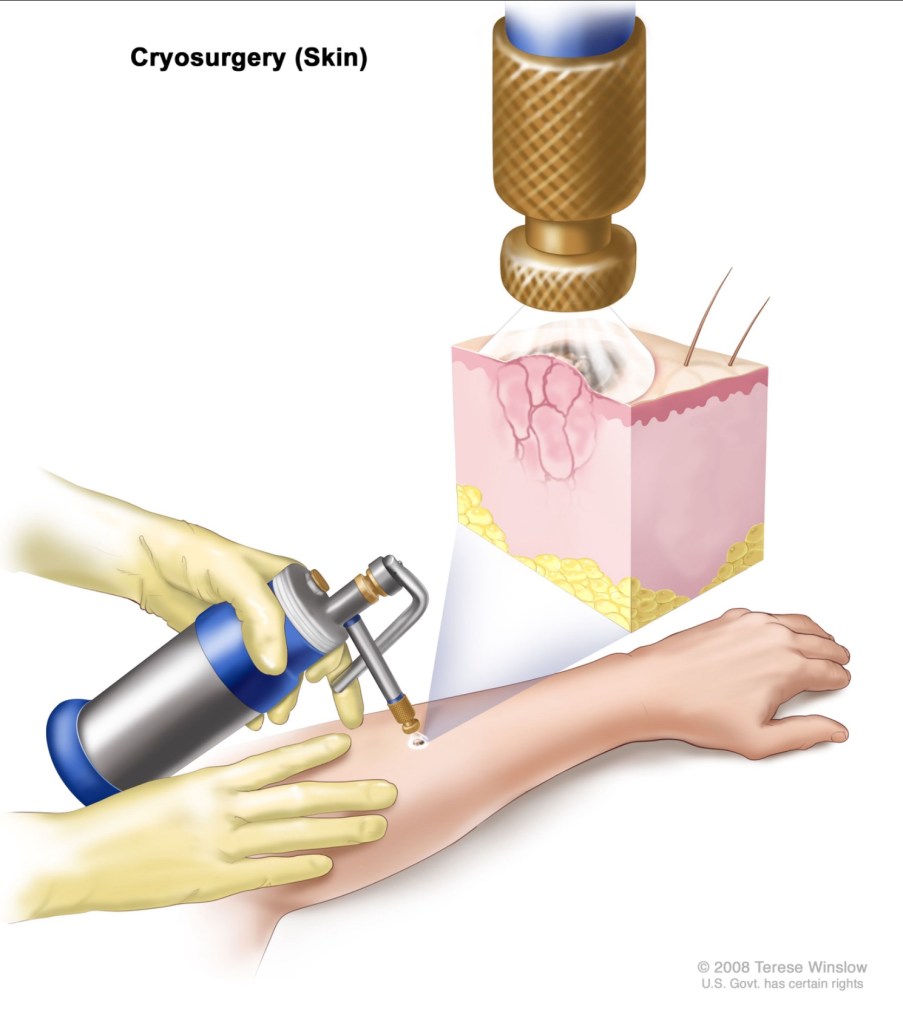
It is a procedure that utilises an extremely cold liquid to freeze or destroy abnormal tissue with the help of an instrument called a cryoprobe. It is also known as cryosurgery or cryotherapy. Gas pumped through the wand-like cryoprobe is used to freeze the tissue. When surgery is not possible, this form of treatment is used to treat several types of cancer.
It’s Story
It’s history dates back to the mid-19th century, Dr. James Arnott tried using salt solutions contains crushed ice to freeze cervical, breast and skin cancers. The temperatures were at -18°C to -24°C.
Even though it used to treat malignant cancers of the eye, brain, head/neck and oesophagus, it is now, commonly used to treat malignant cancers of liver, kidney, lung, prostrate and breast.
It’s Workings
It’s principle (cryoprobe) is that it is based on a high-pressure, closed-loop, gas expansion system. A high pressure, room temperature gas like argon, is forced a narrow opening, and allowed to rapidly expand. Here, it follows the Joule-Thompson effect, when a fluid passes through a restriction, such as a porous plug, a capillary tube, or an ordinary valve, its pressure decreases.
The enthalpy of the fluid remains approximately constant during such a throttling process. Throttling means regulating the supply of fluid through a valve. In other words, gas undergoes a temperature change, when expansion of gas occurs without heat transfer. This theory helps with liquifying of gases.
Nivea Vaz
Manipal College of Medical Sciences, Pokhara
 Scriveners Online©