The introduction to the concept of nanorobotics originated from Richard Feynman’s speech in 1959 on December 29th titled “There’s Plenty of Room at the Bottom.”
He describes on how physics explains what the logical mind sets to answer; the hidden questions that Physics answers with meaning. An ode to important discoveries made to the contributions to the scientific understanding, he diversifies what we understand as Physics to us, that Physics and Biology together, too, can spark up our understanding of the way the universe fundamentally works, Physics lays a scaffolding to building up on our knowledge in Chemistry, computers work in resemblance to the human body systems, they write and erase data in its circuitry, just like DNA and RNA can! Computers are a fascinating element; they were big at his time, now, they are small, they can carry wires and cables and run at gigabyte speeds! Atoms can evapourate and condense in manufacturing, and be a functioning transistor in computers. We can make a prediction to the probability of an error to create objects on a small scale. His obsession with atoms doesn’t stop there! (Yes, I have read it all!) He goes as far to speak of ‘small machines’ that could work their way up to the heart! ‘Hands’ can control the levers to the electrical wires. We, in such an advanced civilisation can make many ‘hands’ perform multiple sets of instructions! It’s a marvelous work of art! We dig up the minerals underground, and modify their atomic structure. Basically, the principles of Physics can broaden our horizons of a new world, one that can create an impossible outcome with substantial answers. In a medical sense, we can build small-scale devices from our prerequisite knowledge of biochemistry and deploy these to work in harmony with the human machinery.

He was an American Physicist during the post World War II era. He was a co-awardee of the Nobel Prize in 1965 for his collective work on Quantum Electrodynamics alongside his colleagues in Physics. This was a joint effort with Sin-Itiro Tomonaga and Julian Schwinger. He provides an inspiration word-letter to scientists who dream of a bigger, and better future; one with possibilities in the field of nanomedicine. An unchartered territory that marks an important cause for research in nanomedicine. A field few know of! This is where nanorobots start to envision the possibilities!
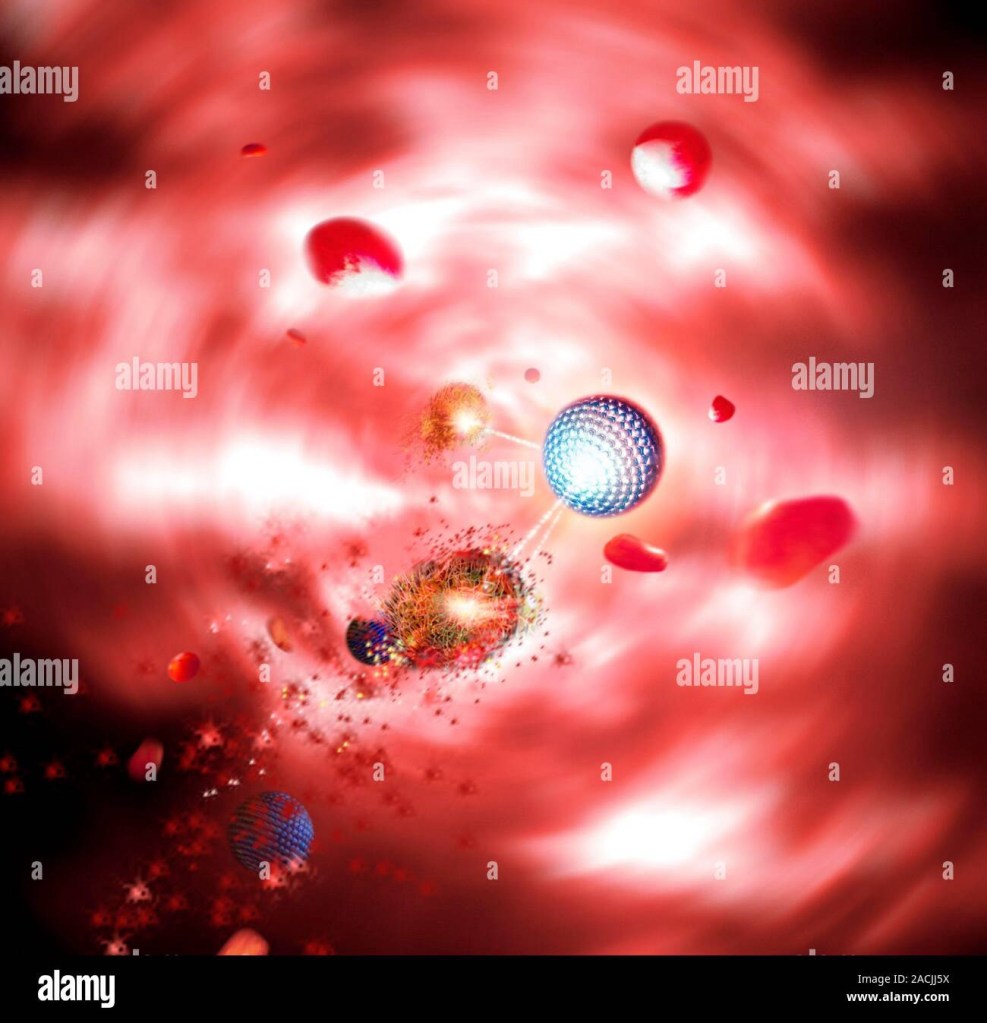
Nanorobots are machines or robots that are near the scale of a nanometre, which is one thousand millionth of a metre. This can be used for many medical applications in various field such as oncology, diabetes, surgery, thrombolysis, drug delivery, precision medicine, and dentistry. It is theorised that biosensors can be used to detect compositional and structural deficiencies in human secretions that expose the unique characteristics for a disease diagnosis.
The recent research into the insights of nanorobots takes us to the Karolinska Institutet in Sweden, where the nanorobots that kill the cancer cells in mice were developed. Inside, is a hidden nanostructure that gets triggered in a tumour micro-environment, that spares the non-tumour cells. This study information is available to read in the journal Nature Nanotechnology. This research group was also involved in developing structures that can organise the death receptors on the cell surface that triggers cell death. The structures contain six peptides or amino acid chains that assemble in a hexagonal pattern. This nanorobot function is as a ‘kill switch’ that was built utilising DNA material called as DNA origami. “This hexagonal nanopattern of peptides becomes a lethal weapon. If you were to administer it as a drug, it would indiscriminately start killing cells in the body, which would not be good. To get around this problem, we have hidden the weapon inside a nanostructure built from DNA.” explains Prof Björn Hög-berg, Department of Medical Biochemistry and Biophysics, Karolinska Institutet who is also the leader of the study. This was what Björn Högberg’s research team has been working on for many years. The ‘kill switch’ is switched on under certain conditions such as low pH, an acidic environment that gets activated when the pH drops from 7.4 to 6.5. It was tested in experimentation by injecting it into mice who suffered from breast cancer tumours.
The results exhibited a 70% reduction of the tumour growth in comparison to the mice who were given an inactive version of the nanorobot. “We now need to investigate wether this works in more advanced cancer models that more closely resemble the real human disease. We also need to find out what side effects the method has before it can be tested on humans.” The researchers are planning to further investigate the possibilities of a nanorobot that can target proteins or peptides on its surface that is capable of binding to certain cancer types.
 Scriveners Online©