Research that worked towards the development and innovation of a bionic based prosthetic limb for helping patients having trouble with mobility due to below the knee amputation has been extremely successful. The funding was done by the MIT K.Lisa Yang Center for Bionics and the Eunice Kennedy Shriver National Institute of Child Health and Human Development. A natural walking gait was made possible with the interface receiving an input messaging from the body’s own nervous system and it is a remarkably groundbreaking technology in itself. This form of treatment is a surgical alteration and insertion of the neuro-prosthetic interface.
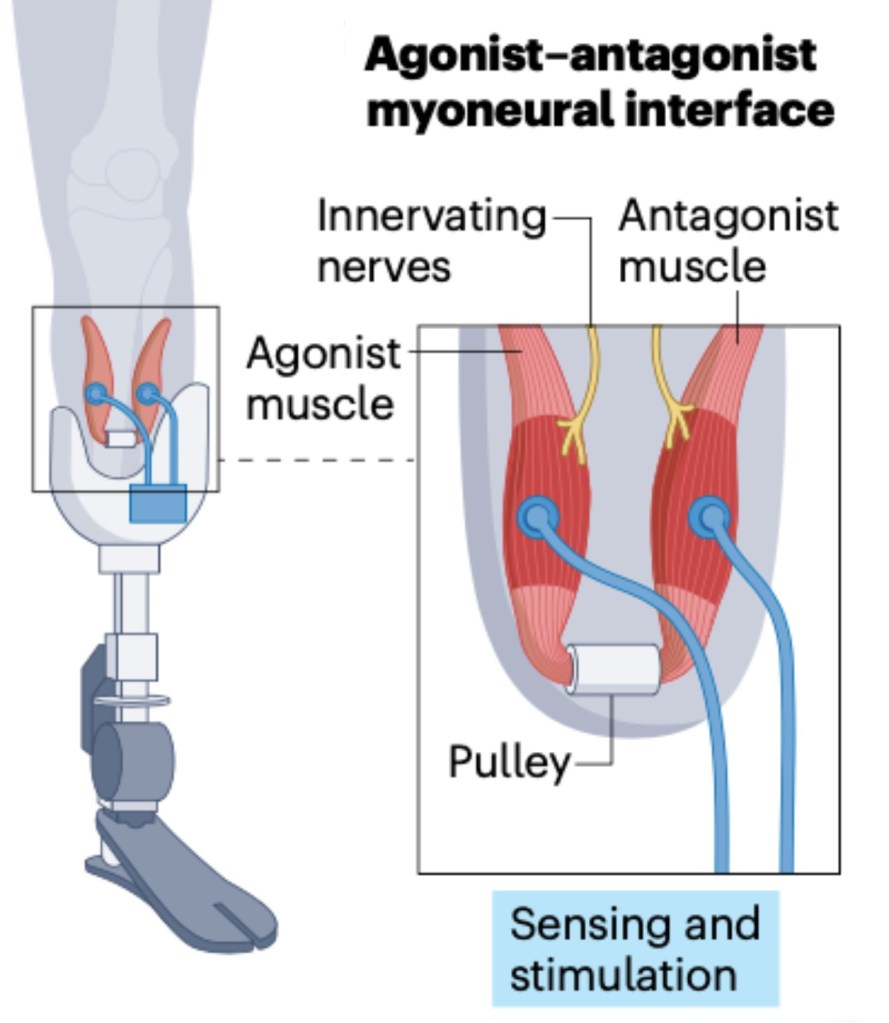
During a traditional below the knee amputation the limb movement that arises from the muscles involved are impaired this makes it hard for the individual to move without any issues. This technology aims to change that! In the test study, seven people who had undergone AMI surgery were compared with the other seven who instead went for below the knee amputation. All of the subjects in the study, had a bionic limb connected to their bodies: this consisted of a prosthesis with a powered ankle with electrodes that can sense electromyography (EMG) signals that were from the muscles of the tibialis anterior and gastrocnemius muscles. The signals reach a robotic controller and this gives information to the attached prosthesis that helps determine the calculations on how much the ankle needs to bend, how much torque needs to be applied and how much power needs to be delivered. Impressively, natural behaviours were observed even though the sensory feedback provided by the AMI is upto just 20%! This study was a subject of exploration that dived deeper in the human-bionic science interactions that can be replicated in the nature of the anatomy itself. The research here also targets for people recognising the attached prosthetic as part of their own body.
AMI stands for agonist-antagonist myoneural interface where the muscles are re-paired and surgically made to be connected to the amputated limb which would bring back the proprioception of the phantom limb to the user. Signals sent by the re-paired muscles are used to control the joint of the bionic prosthesis.
There was a lot of work being put into the creation of these technological limbs for both the upper and lower extremities of the body.
Credit: MIT website
 Scriveners Online©