“The eyes of others our prisons; their thoughts our cages.”
-Virginia Woolf, An Unwritten Novel
When I crave for that sense of dignity and freedom to decide and live my life in a world full of domineering men I look towards women who were daring to dream and accomplish further and bigger things in life… in a time where making life-altering choices that were once considered rebellious are now revolutionary in a true feminist’s eyes…
Ever wondered who the 1st woman in medicine from Portugal was?
Carolina Beatriz Ângelo was one of the first women in Portugal to complete a degree in Medicine and being the first woman to practice surgery.
Carolina was born in April 16, 1878, in the Portuguese town of Guarda. Her father, Viriato Ângelo, owned a printing press where the newspaper O Districto da Guarda was printed. As a journalist, Carolina’s father was an open-minded and supported her daughter when, as a brilliant student, she wanted to be a physician.
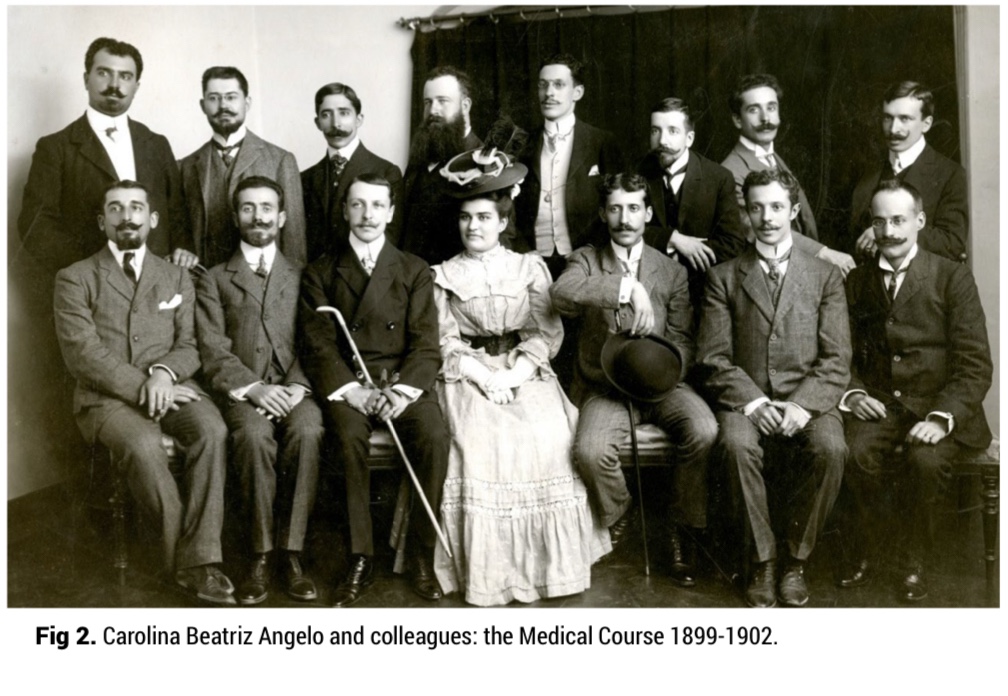
In the year of 1895, she moved to Lisbon, and in 1902, she graduated from the Lisbon Medical-Surgical School. She was one of the first Portuguese female doctors and the first woman to practice surgery. Being a woman among men, she felt no constraints as proudly appears in a photograph among her colleagues. (Fig. 2) In the same year, she married Januário Gonçalves Duarte Barreto (1877-1910), a physician and republican activist. The couple shared the same commit-ment both to medicine and politics.
In that year, feminist and progressive magazines began to be published. Female doctors were part of the movement and a few societies were created, such as “Sociedade Futura” (The Society of the Future) (1902-1904), directed by Adelaide Cabete (1867-1965), also a female physician.
In 1903, Carolina presented her dissertation Genital Prolapses – Clinical Notes, expressing her commitment to improving women´s health since she con-sidered it placed at the background of society. In its prologue, she defined uterine and vaginal prolaps as the object of investigation based on cases she cared. It is worth highlighting her commitment with care during surgery and follow-up in order to reduce complications.
Carolina Beatriz Angelo’s activity was not confined to medicine, which she practiced in her private office at Rua do Almada, 64 in Lisbon. Her struggle for the dignity of women extended to institutional and political grounds.
In 1907, Ana de Castro Osório created the Portuguese Feminist Studies Group. Carolina and two other female doctors were part of the team. That year, she was initiated into Free-masonry, at the Humanity lodge and Adelaide Cabete (1867-1935), another female physician and companion of Carolina, was also initiated at the same lodge. They fought for a fairer and more open society in which women should have an active role.
On June 23, 1910, Carolina’s husband died, aged 33. As a widow and house-holder, she applied on April 4, 1911 for inclusion in the electoral roll. On May 28, 1911. she voted in the elections for the national constituent assembly taking advantage of a “hole in legislation aimed for males, that guaranteed the right of voting to house-holders, which she was because she was a widow bearing two children.
Her dids were reported not only in Portugal but also in foreign newspapers. Carolina Beatriz Angelo was the first woman to vote in Portugal and in Europe.
On October 3, 1911, she died suddenly, aged 33, while returning from a political meeting. On July 13 1913, the electoral laws were cleared excluding women, since such right was exclusively for “Portuguese male citizens over 21 years of age. Only in 1931 the right of voting was allowed in Portugal for women.
In 2012, one hundred and one years later, a new hospital near Lisbon was open bearing her name: Hospital Beatriz Angelo.
ADELAIDE CABETE
“For most of history, Anonymous was a woman.”
-Virginia Woolf, A Room of One’s Own
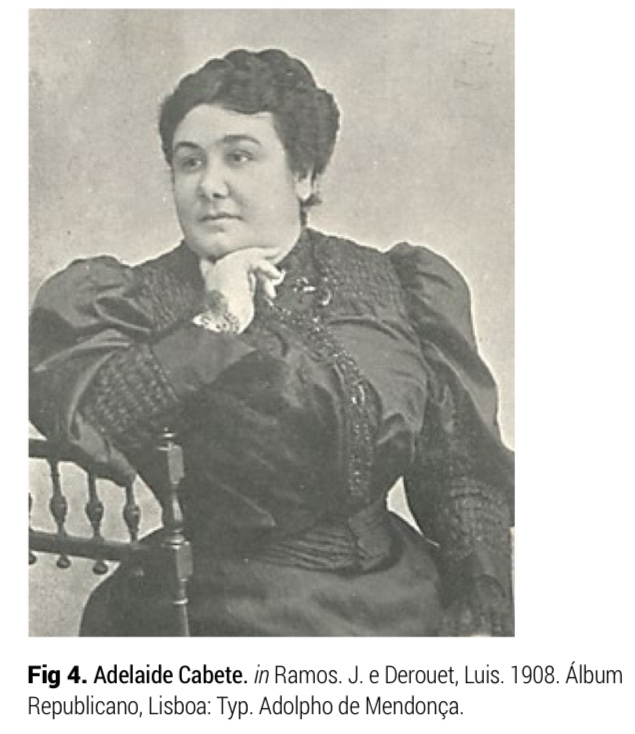
Adelaide de Jesus Damas Brazão was born in 1867, in the small village of Alcáçova, near Elvas, Portu-gal, from a family of rural workers (Eig.4). In 1886, at age of 18, she married to Manuel Ramos Fernandes Cabete (1849-1916), an army sergeant who encouraged her to continue studying. At 22 y, she completed her high school with high rankings being the only woman in her class.
In order to support his wife. Manuel Cabete decided to move to Lisbon so that Adelaide, enter the Lisbon Medi-cal-Surgical School and graduated in 1900, aged 33.
Cabete and her husband, were a perfect match, sharing the same ideals of education and political ac-health and, at the same time, fighting for human and specially women’s rights. She practiced gynecology and obstetrics and proposed a period of rest in the last two months of pregnancy defending that puerperal women should stay in maternity wards for post-partum follow-up, ensuring that hygienic conditions were necessary for the development of healthy newborns. She advised maternity leave, which did not exist. Always bringing together medical science, social and political activities.
Alfredo da Costa (1869-1910), the Professor of gy-naecology and obstetrics at the Lisbon Medical-Surgical School, was her partner in the claim for the construction of a maternity in Lisbon for poor women. She always stood in defence of life, against abortion, but also denounced the terrible conditions in which poor women succumbed to the unprepared hands of midwives. Both advocated a better medical care in neonatology, pediatrics and general social welfare.
She stood out also in the fight against tuberculo-sis, alcoholism, venereal diseases, prostitution and in the support of single mothers. She gave speeches at various educational institutions and left numerous publications in these areas being ‘Alma Feminina” (Female Soul) one of them.
She advised healthier women’s clothing, focusing on old fashion standards from a medical point of view. She disapproved the use of long and tail-back skirts. which could make women stumble and fall. Tight cor-sets, causing internal injuries by compression of the organs and high heels, causing instability and postural complains), Cabete stood against beauty contests, who placed too much emphasis on physical appearance in the detriment of their female qualities. “A little better would be perhaps to put in a contest: Which will be the best daughter, the best wife or the best mother.”
In her medical writings and civic interventions, Cabete always promoted the dignity of women, Cabetes husband died in 1916. She never forgot his kindness and love. In 1929, she moved to Portuguese territory Angola. In 1932, the Maternity Dr. Alfredo da Costa was finally inaugurated in Lisbon. In 1931, the vote was finally available for women and she voted in Luanda (Angola). She was the only woman voting at the plebi-scite for a new Portuguese Political Constitution (1933).
In 1934, she returned to Lisbon and died the next year at the age of 68.
Source:
https://www.jscmed.com/index.php/jscmed/article/download/19/20
 Scriveners Online©