“It’s laughable that sugar is still on the gras list.”
~Dr Walter Willett, Chairman, Department of Nutrition, Harvard TH Chan School of Public Health
In the past 30 years, obesity rates have doubled to 600 million.
The New York Times have proposed that “sugar is toxic” on their issue ‘SWEET AND VICIOUS’ and this got people talking about the controversial topic. Dr Robert H Lustig is one a mission, he wants the world to know that sugar is toxic, more so than anything else not just from his professional work but also that it’s deadly as any other poison there is known to mankind. He’s written a book called “FAT CHANCE.” He’s been an advocate for decades at this point on how companies need to be more transparent about their ingredients, their listing and most importantly the quantity, the grams of sugar that they sell to you so easily! He talks with a national TV news reporter about the “metabolic problems, the hypertension, the diabetes, the heart disease and likely the cancer and the dementia.” He goes onto say in another video with another TV anchor, “And now one-third of America has non-alcoholic fatty liver disease. This is a disease that wasn’t even described until the 1980. It is the biggest epidemic in the history of the world.”
He argues that he wants to known as the “anti-processed guy” instead of the “anti sugar guy” and wishes that this epidemic never existed to begin with. In Okinawa, the younger generations consume the unhealthy western diet compared to their elderly counterparts. They are at a higher risk for cardiovascular disease, obesity, and diabetes and are linked to foods that have a higher sugar, salt and fat intake. Japan has the fifth largest number of diabetes patients worldwide. Simple bar graphs show that consumption of processed foods and sweets rose from 1982 to 11.6% to 22.9% in the year of 2012. 74% of the foods are spiked with added sugar he adds in the shopping aisle. Sugar has 56 names few of them are sugar, table sugar, high fructose corn syrup, cane sugar, beet sugar, agave, maple syrup and honey. One has to consider that it’s the same scenario when it comes to “calorie for calorie,” “gram for gram,” “ounce for ounce.”“They’re all the same and they do the exact same thing,” he recollects.

Defining the Limits
What is moderation?
Moderation is 6-9 teaspoons of added sugar according to the AHA. WHO says it’s upto 12 teaspoons of added sugar. Europe consumes 17 teaspoons of added sugar per day and America is at 19.5 teaspoons of added sugar per day.
Unique Case Study of Alexis Gomez
She’s a former patient of Dr Lustig. She recounts her story, it started at her freshman year of high school, she was overweight at 10 years old, her ultrasound scan revealed that she had a fatty liver disease. He talks of his first patient who was a 13 year old, he was diagnosed with type 2 diabetes and fatty liver disease and that his ALT was in the “100s” range. Now all his patients have it! It’s a common thing in paediatrics. Teenagers consume on average 30 to 41 teaspoons of total sugars per day.
A Companies and a Major Financial Gain
The Great Western Sugar Company

Around that time, there were two sides of the debate as to how harmful sugar truly is! This was in the late 60s and early 70s. Ironically, not much has changed even after all the modern inventions that surround us there’s still a lot of controversy! It’s a fact that it’s still the same debates, the same questions, and the same research. It was repeated and discussed. The companies would go all out for a public relations campaign to shape the public opinion. The company would fund research and scientists to promote their side of the story, that sugar wasn’t harmful or to be feared on. It started with countries like the US, Canada, Cuba, Haiti, and later when the situation felt threatening it included more countries such as England, Australia, South Africa, France and Belgium. In the late 60s, the Sugar Research Foundation, Inc changed their name to the International Sugar Research Foundation, Inc. They were not to mention definitely on statements that sugar causes disease as policymakers could find out. Data shows that some calories cause more disease than others because different calories are metabolised differently.

When the liver converts excess sugars into fats it increases one’s risk for fatty liver disease, diabetes and heart disease. It’s the same context as that of foie gras when we take a look at it, it’s like forceful feeding of sugars. Except in our case it’s too pleasurable to call it ‘force-feeding.’ The company found out that sugar was undoubtedly harmful. And they were credited for this. It was in the 60s, people realised the sugar problem.
Dr John Yudkin is a British Physiologist and Nutritionist who wrote a book in 1972 called “Pure, White and Deadly” and he had a lot of information about how sugar was disease causing and it’s a requirement to reduce its consumption. Dr Ancel Keys was another doctor who said that fats was actually the dietary problem instead. There was constant argument between the two physicians over whose findings were actually right. The International Sugar Research Foundation was keen to contradict Dr Yudkin’s claims. Dr Keys was paid to keep up with the counterclaims to Dr Yudkin’s research. Keys would write “Yudkin provided no validation for his method. His generalisations are simply erroneous.”
Unfortunately, a lot of researchers would pick the side of the ‘dietary fat hypothesis’ and small minority would take his side. This is when low-fat alternatives became desirable and it also meant added sugars were present.
Sugar Coated is a health documentary released in 2015.
According to the FDA,
Let the Nutrition Facts Label Be Your Guide
The Nutrition Facts label can help you compare and choose foods that are lower in added sugars.
Check the label to see if foods are LOW or HIGH in added sugars.
- 5% DV or less is a LOW source of added sugars
- 20% DV or more is a HIGH source of added sugars

Dr Yoni Freedhoff says that we still use too much sugar. “Both as its capacity as an ingredient that tastes good. But more as an ingredient that leads to greater sugar consumption.” There’s a program run by the heart and stroke foundation called as ‘Health Check’ and there’s a little tick in a box that’s on the labels of foodstuffs and beverages. People believe that the product is healthy, good for them and that it’s endorsed by the Heart and Stroke Foundation. “He adds that the stamps are also on fruit gummies and fruit leathers and they have more sugars than actual candies. But now they are advertising those candies on the front of package as servings of fruit with that health check endorsement.” The food industry has continued to provide grants for sugar research to scientists. Public policy initiatives have called on taxation of these added sugars in our food and beverages. On June 18, 2014 the Heart and Stroke Foundation dropped their Health Check Program. The Heart and Stroke Foundation also came out with the first Canadian Guidelines that severely limit sugar consumption.
The White House Strategy on Hunger, Nutrition, and Health notes that the intake of added sugars for most Americans is higher than what is recommended by the Dietary Guidelines for Americans and calls for FDA, in collaboration with other HHS divisions and USDA, to hold a public meeting regarding future steps that can be taken to reduce added sugars consumption in the United States. FDA will host, in collaboration with other federal partners, a virtual public meeting which was on November 6, 2023 followed by virtual public listening sessions which was on November 7-8, 2023 to discuss strategies for reducing added sugars consumption in the United States.

Think the conversation on sugar research is over? THINK AGAIN!
Additional reading content:
https://youtu.be/odZlKkGkOVI?si=RL7YGDH7zARURpmZ
https://www.ucs.org/sites/default/files/2019-09/added-sugar-subtracted-science.pdf
Sources: Sugar Coated, Higher Road to You YouTube, https://www.fda.gov/food/nutrition-facts-label/added-sugars-nutrition-facts-label#:~:text=The%20Dietary%20Guidelines%20for%20Americans,of%20added%20sugars%20per%20day., https://www.fda.gov/food/hfp-constituent-updates/fda-hold-virtual-public-meeting-and-listening-sessions-strategies-reduce-added-sugars-consumption#:~:text=During%20the%20event%2C%20there%20will,available%20on%20the%20meeting%20page.,Inside the Studio-The Texas Heart Institute
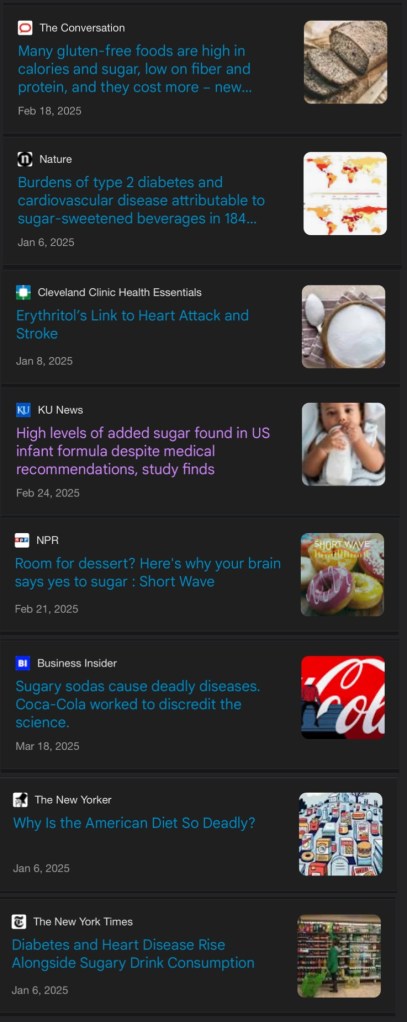
Extras: https://theconversation.com/many-gluten-free-foods-are-high-in-calories-and-sugar-low-on-fiber-and-protein-and-they-cost-more-new-research-247165, https://www.nature.com/articles/s41591-024-03345-4, https://health.clevelandclinic.org/erythritol, https://news.ku.edu/news/article/report-reveals-high-levels-of-added-sugar-in-us-infant-formula-despite-medical-recommendations, https://www.npr.org/2025/02/21/1232862552/sugar-desserts-brain-craving-science, https://www.businessinsider.com/coca-cola-misled-america-about-soda-science-sweet-deadly-book-2025-3, https://www.newyorker.com/magazine/2025/01/13/why-is-the-american-diet-so-deadly, https://www.nytimes.com/2025/01/06/health/sugary-soda-beverages-diabetes-heart-disease.html
 Scriveners Online©