“In medicine and indeed other professions, we are hurtling through life, grappling with a complex, demanding and stressful existence. This is all about human beings reaching their full potential.”
~Dr Ratna Makker FRCA, MA (Med Ed) AOME
Mrs Emma Sue trains healthcare professionals through various toolkits and workshops that are run across the UK. There are 7 soft skills that she shares in her book “7 Skills for the Future.”
Why these 7 skills matter to us physicians and surgeons?
•equipped to deal effectively and gracefully with information overload
•strategies to respond well to change
•thrive despite uncertain work options and an uncertain future
•know how to get work-balance right
•get better at taking risks, making decisions, working collaboratively and having great ideas
1. Adaptability
•Advances in technology mean that we have got to keep learning and evolving.
•Remote work teams and telecommunicating are fast becoming everyday.
•Multiple generations in the workplace and home mean that we need to embrace different attitudes, ways of working and living.
•We need to embrace innovation.
•Most people are struggling with major changes to their lifestyle and work perhaps for economic reasons: being made redundant or not being able to find work easily.
What sort of things make a person adaptable?
These are the important four skills:
- Intellectual flexibility-this means keeping an open mind, being able to integrate new information smoothly and easily and switch easily from detail to the big picture.
- Being receptive-especially to change!
- Creativity-actively seeking out new things and not being afraid to experiment and improvise.
- Communication style-which can be adjusted to suit different contexts or situations.
Mental Scripts
It (our brain) creates what is known as ‘behavioural scripts’ which are mental models that automate our actions. An example is how our brains might build a behavioural script for riding a bike. Through practice, this behaviour becomes entrenched and automatic until we can do it without thinking. Mental scripts can also be linked to limiting beliefs. Limiting beliefs are the internal thoughts that inhibit what we are willing to commit to or do. Many of our limiting beliefs have been held for a long time, and once a limiting belief has been created, we often construct our lives to avoid breaching that belief. Sounds crazy but it’s what we do! If we believe we’re not confident, we’ll avoid activities that push us out of our comfort zone.
7 steps to adaptability
- Stick at things
- Be willing to learn
- Improvise
- Flex those muscles
- Adopt a ‘can do’ positive attitude to change
- Get creative at problem solving
- Have a survivor attitude
2. Critical Thinking
The 4Cs
- Critical thinking and problem solving-the ability to make decisions, solve problems and take appropriate action.
- Communication-the ability to synthesise and transmit ideas, both verbally and in writing.
- Collaboration and team building-working effectively with others, including people with opposing points of view and with diverse groups.
- Creativity and innovation-being able to see what is missing and fix it.
•Thinking critically means you ask more questions , look for relevant information, think open-mindedly and communicate well to find effective solutions.
•Developing your capacity to think more critically will impact the quality of your decisions and judgements. They will be more informed and less biased or subjective.
How to improve our creative thinking skills;
- Inhibitory control- This is the ability to resist the strong inclination to do one thing in order to do something else that is more appropriate, or would better help you to reach a goal.
- Working memory- This is a mental ‘jotting pad’ feature of your brain that shares important information that you can U.S. win the course of everyday life, helping you to stay focused on a task, block out distractions and keep you aware.
- Cognitive flexibility- is our human ability to switch behavioural responses according to the context of the situation.
Six key principles to rethink our critical skills!
- How we make sense of things
- Novel and adaptive thinking is needed more than ever
- Computational thinking
- New media literacy
- Managing our cognitive load
- Becoming T-shaped-they being deep understanding of at least one field and often two or more, and they also have the capacity to converse in the language of a wider depth and breadth of fields.
Ideologies that will stagger your critical thinking;
Tendency No. 1: Confirmation bias
Tendency No. 2: Attribution Bias
Tendency No. 3: Trusting hearsay
Tendency No. 4: Memory lapses
Tendency No. 5: Accepting authority without question
Tendency No. 6: Not admitting you don’t know all the facts
Winner outlines the key elements of social thinking:
- Our thoughts and emotions are strongly connected.
- We think about others, even if we have no intention of interact with them.
- We ‘think with our eyes’ in order to figure out other people’s thoughts, intentions and emotions.
7 steps to critical thinking
- Question your assumptions
- Adopt different perspectives
- Get creative
- Build in reflection time
- Get past face value
- Build your skills
3. Empathy
Empathy according to Brene Brown is
•being able to see the world as others see it
•being non-judgemental
•understanding another person’s feelings
•communicating your understanding of that person’s feelings
There are three kinds of empathy;
•Cognitive-this is being able to understand another’s perspective.
•Emotional-the ability to feel what someone else feels is bound up with deep responses within our brain.
•Empathetic concern-the ability to sense what another person needs from you.
In a popular Harvard Business Review article, “What makes a leader,” Goldman isolates three reasons why empathy plays such an important role, particularly now:
- The increasing use of teams, both virtual and face-to-face
- The rapid pace of globalisation
- The growing need to retain talent
7 steps to empathy
- When were you last empathetic?
- Think about the last argument you had and what happened.
- Have a conversation where you actually listen.
- Slow down
- Get better at reading faces and body language
- Think about outcomes
4. Integrity
Some common myths about integrity:
- Integrity just means being honest and straightforward
- A balanced and compartmentalised life means a life of integrity
- Integrity is a natural quality. It’s effortless, just ‘part of who you are’ and you either have it or don’t.
When we talk about integrity, we sometimes miss out on the importance of consistency, honesty and truthfulness or accuracy of one’s actions.
Stephen Carter, in his book ‘Integrity,’ defines integrity as a virtue of character that requires three steps: 1) discerning what is right and what is wrong; 2) acting on what you have discovered, even at personal cost; and 3) saying openly that you are acting on your understanding of right from wrong.
7 steps to integrity
- Start with working out what your values are
- Be responsible
- If you have let someone down, do it with integrity
- Be personally accountable
- Start with yourself
- Be boring
- Manage expectations
5. Optimism
Tali Sharot, in ‘The Optimism Bias,’ says that we need to be able to imagine alternative realities and need to believe that we can achieve them. That is, in essence, where this bias or tendency comes from. Such faith helps motivate us and pursue our goals. Optimists generally work longer hours and tend to earn more.
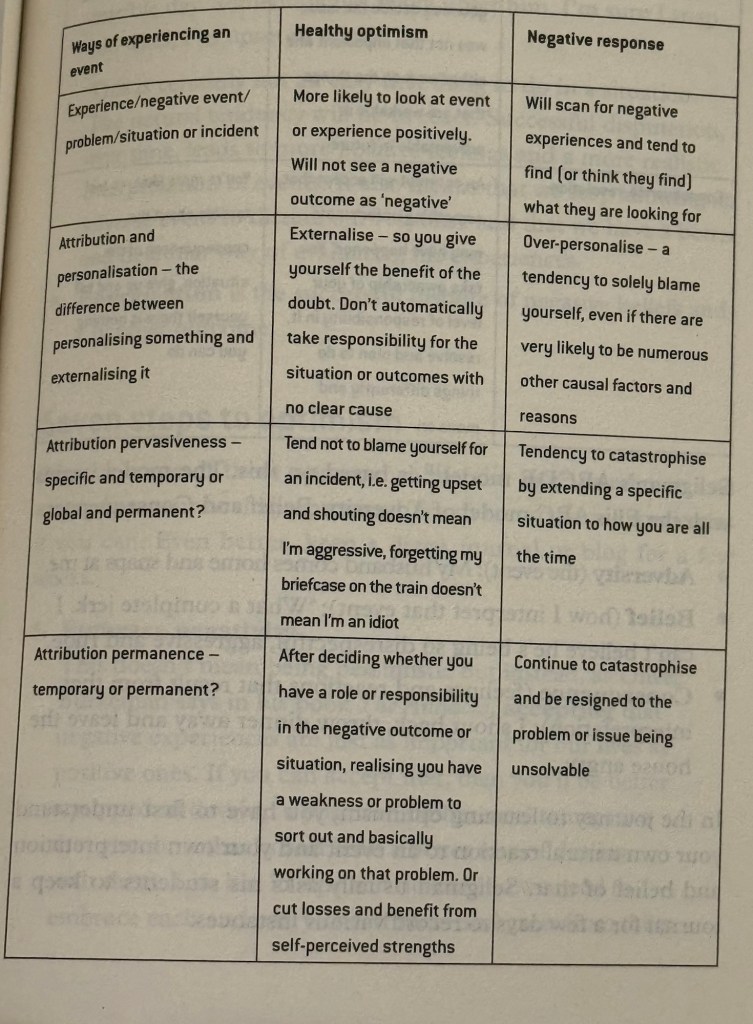
The Hallmarks of Healthy Optimism Include:
- Accurately assessing a situation, including asking questions, questioning assumptions, weighing up the facts, differentiating between facts and feelings and having a perspective.
- Seeing problems as temporary and not pervasive. Being able to acknowledge your own role within a situation, feelings and actions. Less blame laid on self or external factors.
- Having faith in your own ability to implement solutions, adjust and move forward constructively. Knowing that there is something you can do. You may not be able to change an external situation, but you can be more in control of yourself within it.

The ABCDE model and explanatory styles
Seligman’s ABCDE model is based on this. The model begins with the Ellis ABC model of Adversity, Belief and Consequence:
•Adversity (the event): My husband comes home and snaps at me
•Belief (how I interpret that event): ‘What complete jerk. I can’t believe he’s being so disrespectful, aggressive and rude.”
•Consequence (feelings and reactions that result from that interpretation): I shout back, throw dinner away and leave the house angry.
Seligman then adds ‘D’ and ‘E’ to the model. These are Disputation and Energisation:
•Disputation: (provide counter-evidence to dispute either my interpretation of things or the cause of the event): I am over reacting. I don’t like this shouting but maybe he’s had bad news. It’s not like him to be aggressive. He must have had a terrible day. Something has really upset him. I’m sure I snap too when I’m upset or angry.”
•Energisation is the successful dispute of negative beliefs and a happier outcome.
Successful disputation, over time, leads to more positive feelings and a more realistic interpretation of events.
7 steps to optimism
- Embrace negativity
- Rethink happiness
- It’s as easy as ABC… DE
- Ditch the self-help books [Subjective experience in my humble opinion]
- Stop trying to think positively
- Find ways to relieve anxiety and worry
- Make time for gratitude
6. Being proactive
There are two aspects to being pro-active:
•Long-term and strategic- This means being open for new opportunities, anticipating and preventing problems, persevering despite obstacles, achieving positive results and taking control of your own life.
•Short term- this means small things you can do in the moment, how you use that space between stimulus and response and, more importantly, making sure that space gets bigger, whether that is reflecting before you respond to that email, focusing and listening attentively, making time for yourself or taking a deep breath before you respond to an aggressive colleague or both.
Being proactive boils down to the four things:
- Self-awareness: being aware of negative reactions to change to positive actions.
- Willpower: having advice for its best effect future building up its strength.
- Responsibility
- Self-mastery
Teaching or helping others to be more proactive is made up of two main components:
- Taking responsibility fora action instead of expecting someone else to think for me, and
- Systemic view- an ability to understand how making a change or shift will impact something in the future.
7 steps to being proactive
- Watch your language
- Commit to being proactive
- Take stock
- Learn something new
- Start something in your community
- Whatever it is, begin it
- Light up the room
7. Resilience
How resilient you are come down to three main areas:
- Your personality and individual characteristics
- Your environment
- You and your environment
Someone who is resilient shares these;
•They tend to have a clear and focus-specific goals they are working towards proactively.
•They are self-aware and have a good sense of their strengths and weaknesses.
•They tend to respond to negative events positively and flexibly.
•They take risks and learn from their mistakes.
•They have clear driving values and a distinct sense of purpose in their lives.
•They are often reflective and value situations and events carefully.
•They have a strong personal and professional support network around them.
Adversity can develop resilience. To be resilient increased most during toughest times.
Optimism works hand in hand alongside resilience.
7 steps to resilience
- Get some perspective
- Know how to manage stress
- Know your strengths- trust and use them
- Build proactively into your life
- Look after yourself
- Manage conflict
- Take more risks
Source: 7 Skills for the Future- Emma Sue Prince
 Scriveners Online©