Dr David Nott is a surgeon and for the most part of the year of 1994, he works at three hospitals in London: St. Mary’s as a consultant vascular and trauma surgeon, the Royal Marsden helps other cancer surgeons removes large tumours en bloc and then performs extensive vascular reconstruction, and at Chelsea and Westminster he is a consultant laparoscopic and keyhole surgeon. In the war conflicted countries however he is a trauma surgeon working in hospitals dutifully serving the injured civilians in the heavily bombarded countries.
His father used to be a practicing orthopaedic surgeon and his mother was a nurse. His mother was born in a small village called Trelech in Wales and was determined to pursue the career pathway of being a nurse after being partly inspired by one of the district nurses who had delivered one of her very own sisters. She had gone to Newport and it was here where she met Dr Malcolm Nott, a junior doctor of Indian-Burmese origin. In his early childhood, his dad would buy him model airplanes the ones from the Airflix kits that were of the second world war aircraft. And he would help him pin them to the ceiling of is bedroom once they were ready. As a youth he dreamed of being a pilot someday as a profession, his hero was Ray Roberts but his father had other plans. He wanted him to be a doctor and advised he do his A levels instead.
He opens up on how hard the MRCS was even for the best surgeons and that it was difficult to clear and it was accomplished after four attempts! On passing his fellowship exam and gaining his FRCS, his parents took him out to dinner in Manchester to celebrate and watch the film The Killing Fields after. The film depicts the civil war between the government forces and the Khmer Rouge in Cambodia and it had a huge impact on him. He recalls that surgery in the 1980s “was a trial of sleep deprivation, of how much you could take before you broke.”
He admits that even as a child, he loved to model make the planes in utter fascination, he was still uncomfortable with the idea of working alongside the armed forces, it just did not align with his ideology of humanitarian work. He was still gripped in wonder reading the stories of war. His real motive at the end of the day though was to learn, use that knowledge and then share it with his colleagues. When he signed up, he was given the rank of a Squadron Leader which was the lowest rank offered to qualified surgeons at that time and was told that he was going to work in Basra in 2007. During the initial time period of the invasion of Iraq, the British forces remained in control after the regime’s collapse, and this was when Dr Nott applied for volunteer work regularly for the MSF and the ICRC, going repeatedly to different African countries.
MISSION 1#
EN ROUTE TO SYRIA
GOVERNING BODY; MSF
LOCATION – SYRIA
There were suppression of protests demanding for President Assad’s removal. In March of 2011, some children sprayed graffiti that were anti-government on the walls, Assad’s solution was to detain these children using security forces and torture them. Protesters responded by taking the matter to the streets.
On the 22nd of March, his forces stormed the hospital, occupied the building and positioned the snipers on the roof. When the protests escalated the snipers got to work. A surgeon named Ali al-Mahameed was killed attending to the wounded and when thousands of mourners turned up to his funeral later that day, they were shot by the snipers. These snipers remained stationed on the roof for 2 years. The healthcare system was weaponized by the regime; the functioning government hospitals were nothing but an extension of security that was loyal and dedicated to Assad’s whim and call.
Our MSF surgical agent flew to Istanbul then proceeded to Hatay and eventually near Reyhanli a Turkish town that was closest to the Syrian border. He remained he MSF safe house where he was briefed on the mission, the latest security alerts and the escape routes in case of emergency evacuations. The following day a Syrian driver and a Syrian logistician picked him up to be taken to a checkpoint just before the border, he would be given a false name that was signed and given some papers. He was under the watchful eye of the Turkish military when we take to the border, who also checked his papers. The border the was just a barbed wire fence was crossed and they waited for a Syrian car to take him to the hospital in Atmeh.
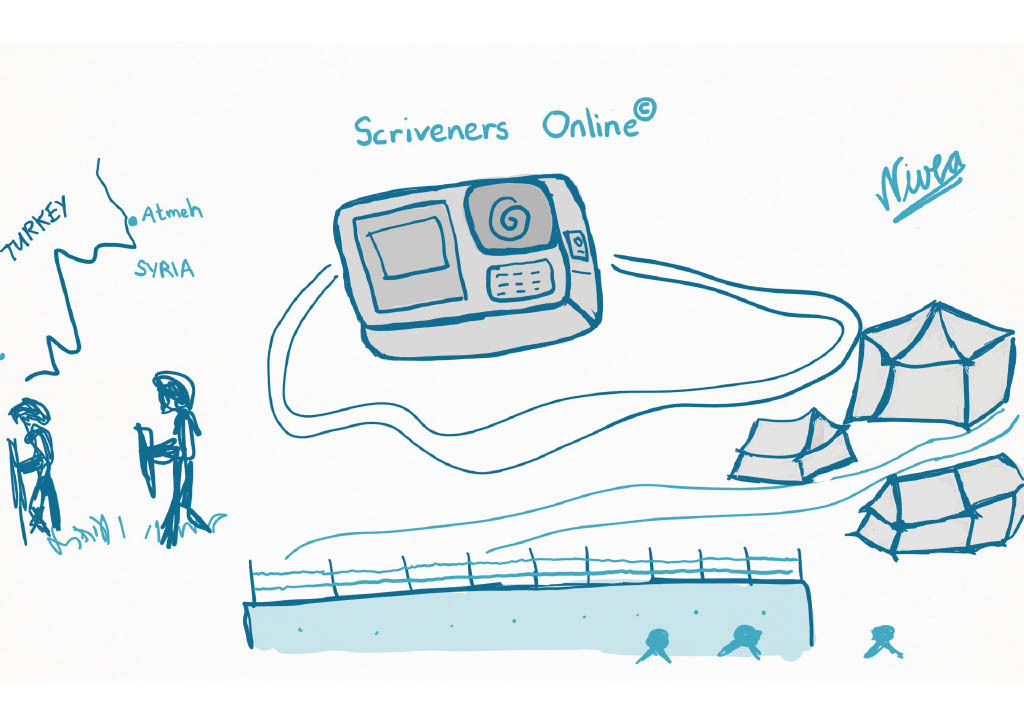
They passed by a few refugee camps that were under poor sanitary conditions. MSF had taken over a large walled villa in the town and converted it into a hospital, code-named Alpha, it was the first facility of its kind to be set up in Syria. The house was large and well-proportioned and it had happened to belong to a surgeon himself who was working in Aleppo. The rooms were repurposed; the dining room was an operating theatre, the living room was the emergency department- the patients would be assessed first, the kitchen-sterilisation unit.
The 1st and the 2nd floors were wards with about 20 beds and the staff accommodation was on the top floor. There were a mix of Syrian and foreign volunteers like Nott himself. After the ward round in Atmeh, they’d have breakfast and start on any scheduled operations. Since this was the early stage of war, they were not overrun with causalities and there was time to do elective/follow-up surgery for people whose lives were not in immediate danger.
Soon, things heated up. A lot of emergency surgery took place; there was gunshot wounds and fragmentation injuries as the regime began to shell civilian homes and fire rockets from the helicopters. There was no longer the usual primary risk of a direct hit but also killing or amputation. Small factories opened up in Atmeh creating explosives. People making them put their families to risk at home. A bomb detonated prematurely in a kitchen of a couple, the husband-the bombmaker was killed and the wife was rushed to the hospital, she had a fragment injury to her lower left leg. An anaesthesiologist took a quick blood sample and she had 4 grams per litre; the normal amount is between 12 and 15g/L. She clearly lost a huge amount of blood; he found out her blood type and went to get a fresh pint of blood after establishing her blood group.
The trolley was set up with sterile drapes and instruments by the sister in charge as she was administered a general anaesthetic, all of this occurred in the dining room. It was impossible to assess the wound properly as there was arterial bleeding, most likely from the superficial femoral artery in the left leg. The large dressing on top acted as a local compression. He scrubbed up and prepared to operate. The limb was prepped with iodine, and the helper took off the pressure dressing, one of the Syrian assistants were helping lift the leg. The bleeding had stopped and there was a large clot overlying the wound. The patient who was now draped and prepped, had an incision below the tourniquet high on the leg so as to clamp the artery before exploring the wound.
After gaining proximal control of the blood vessel, he went down to have a look. A finger into a large hole just above her knee joint, which Dr Nott assumed was a piece of metal, a fragment of a bomb or maybe a bit of the house. On probing with his finger he found a smooth cylindrical object, on showing it to the Syrian helper, his face turned pale. He blurted out “Mufajir” before leaving out of the room. Mufajir means detonator. He looked at the anaesthesiologist who looked right back at him. The Anaesthesiologist told him to wait, in came back the Syrian helper who provided a bucket of water and he carefully dropped it down. The Anaesthesiologist ran to the safety of the next room. The sunsets were particularly striking so the surgeon decided to take a photograph of it, his set up was a go pro camera mounted on a headband, a sudden appearance of the hospital logistician who burst out on the roof asked him to stop it. The fighters next door probably belonged to some jihadi group were watching him from a distance.
Fortunately, with Isa’s help he managed to get his camera back. He was upset to find out he was killed about twelve months later, dying from a shell injury while he was working at his clinic in Idlib and which was blamed on the Syrian government forces.
(PS I worked on a new device for this ✍️ edit, and illustration and I couldn’t be bothered about the differences!🙃)
He also trains doctors and surgeons in war affiliated countries through his own foundation called the David Nott Foundation:
Source:
War Doctor-David Nott (2019) 2020 Edition
 Scriveners Online©