A perfect example of how scientific data and outcomes caused by pure ignorance, dirty politics and unsatisfied vaccine results failed humanity

The Rt Hon the Baroness Hallett DBE, addressed the challenge of the COVID-19 Inquiry, by dividing the situationship of each constituent countries in chronological order of events that have unfolded in the chaos and disastrous consequences of failed core political and administrative decision-making across the UK in response to the COVID-19 pandemic.


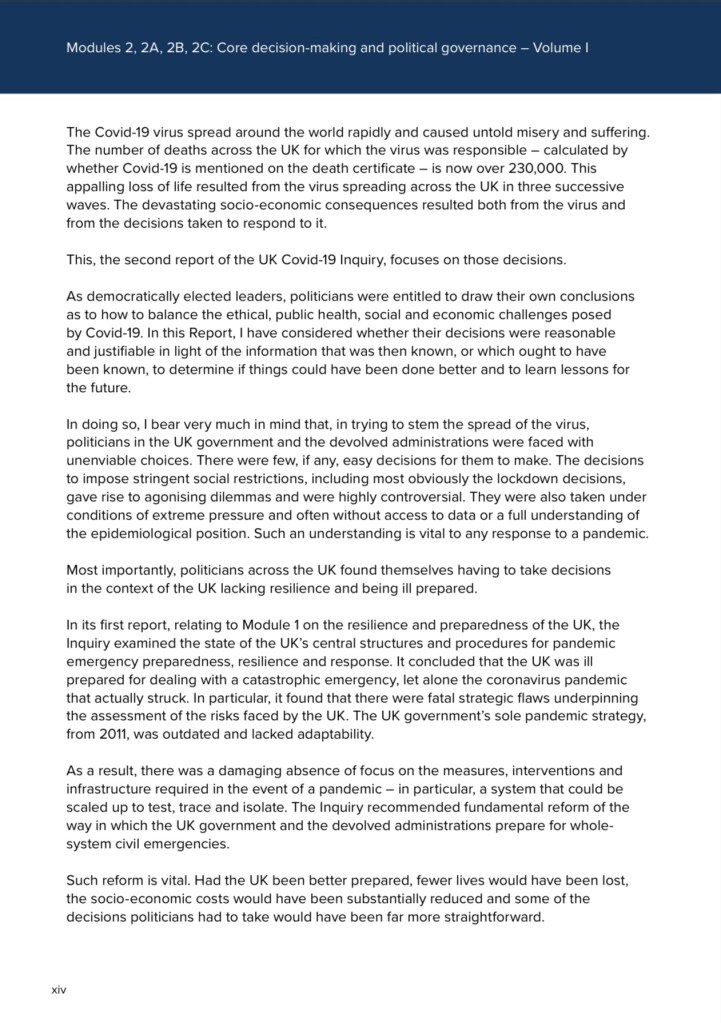


There is a comparison of the contrasting administrative decision-making made by the four governments responding to the COVID-19 pandemic.
Future reports will continue to focus on areas specifically pertaining to
- Healthcare systems
- Vaccines and therapeutics
- Procurement and distribution of key equipment and supplies
- The care sector
- Test, trace and isolate programmes
- Children and young people
- The economic response to the pandemic
- The impact on society
This is a second report containing a set of modules; Module 2-UK, Module-2A -Scotland, Module 2B-Wales, and Module 2C-Northern Ireland.
The Key Findings are broken down as follows in short lines;
The emergence of COVID-19
There was a lack of preparedness, information and a lack of urgency when it came to approaching an initial response. A limited testing capacity and lack of surveillance meant that the decision making failed to carry out measures that would eventually limit/contain the virus spread. This was further compounded by the Department of Health and Social Care into believing that the UK was well-prepared for controlling and containing an epidemic that was cousin to the common cold. (Distantly for that matter!)
The administrators were dependent on the government rather than creating a response of their own.
The first UK-wide lockdown
By the 13th of March 2020 it was obvious that the true cases were several times higher than the estimates like to predict. This would inevitably cause an already overwhelmed NHS to tirelessly lose reigns over the waiting lists period.
If it was taken up 1 week earlier there would be approx 23,000 deaths when the first wave occurred until 1st July 2020.
All the four governments were given strong advice to impose a lockdown.
Exiting the first lockdown
While entering the 1st lockdown, none of the four governments had any strategy on how to exit the lockdown. On the 4th of July 2020, majority of England’s restrictions were eased. This was a time period when the high-risk infections were rampant.
There was also little planning as to how to effectively strategize for the second wave of the pandemic.
The second wave
The UK government, the Welsh government and the Northern Ireland introduced the restriction too late and the rising rates of autumn 2020 meant they could not control the virus spread.
A lockdown of the ‘circuit-breaker’ kind was introduced in late September to early October of the same year, meanwhile, the second lockdown imposed on England on 5th November could have shorter or avoided all together.
In Wales, the government did not increase the restriction period until 23rd October despite being advised top do so on the 5th of October 2020.
In Northern Ireland, politics had divided the Executive Committee meetings that led to chaos, A four week was introduced instead of the advised six-week intervention.
In Scotland, measures targeted in the locality instead of the entire nation meant cases had grown to be more gradual.
The vaccination rollout of the Delta and Omicron variants
On December of 2020, the UK was the first to approve for a vaccine and for the commencement of a vaccination programme.
The Delta variant emerged in March 2021, the government delayed planned relations and allowed for the rollout of the vaccine, the vaccine was the main emphasis.
The Omicron variant, was less severe and more transmissible emerged in the winter of 2021, the conferred protection of the vaccine meant that more than 30,000 people died with COVID-19 between November 2021 and June 2022
Specific Recommendations include;
- Improving consideration of the impact that decisions might have on those most at risk in an emergency
- Broadening participation in SAGE (The Scientific Advisory Group for Emergencies)
- Reforming and clarifying the structures for decision-making during emergencies within each nation
- Ensuring that decisions and their implications are clearly communicated to the public
- Enabling greater parliamentary scrutiny to the use of emergency powers
- Establishing structures to improve the communication between the for nations during an emergency
Picture Credit;
https://covid19.public-inquiry.uk/hearings/
Sources;
UK Covid-19 Inquiry YouTube
 Scriveners Online©