“A normal brain on EEG is chaos,” Najm explained. “The heart actually it’s very interesting. When you have the heart working, what does it do? It pumps the whole muscle in unison. It pumps together and that’s why you have this big spike. The brain actually, each group of neurons from like say this area, they don’t talk to next door neurons, they talk to in the back, in the front, in the different area of the brain.”
“We cannot have enough pairs of eyes to monitor them because our goal is to see these patients in the intensive care unit, in the epilepsy monitoring unit, looking for changes in their status,” Najm said. “We want to find out if a patient in the ICU is having a seizure or not, because if they do have a seizure, we need to treat it very fast, otherwise their condition will deteriorate.”
Even in the best case scenario, untreated seizures lead to longer ICU stays.
“We want to basically be able to detect something when it’s happening so we can alert the treating team to just start treating,” Najm said.
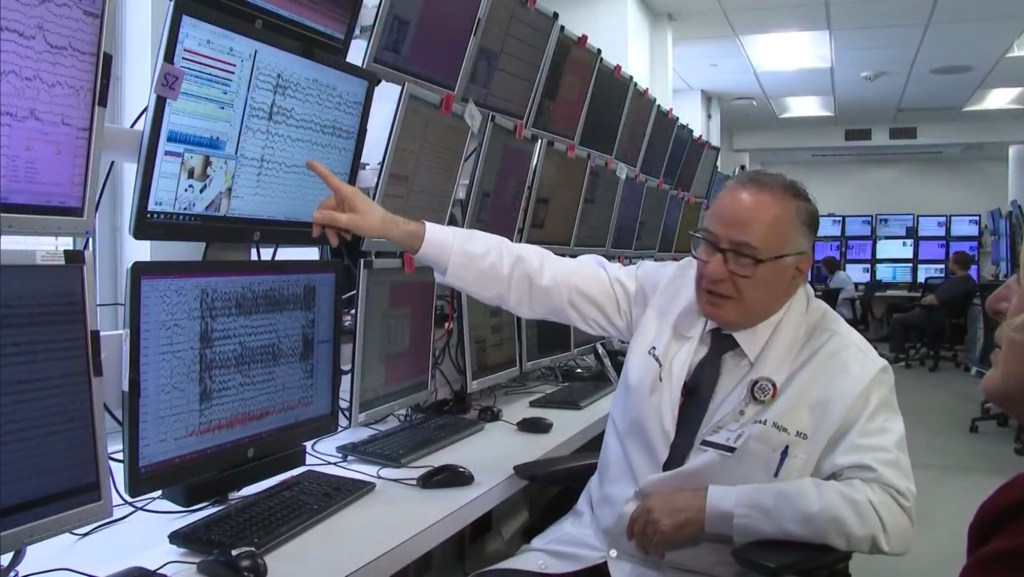
“What epilepsy is actually is to transform the brain from chaos to organization,” Najm said, showing an EEG recording of a seizure. “This is a storm here hitting the brain. This is seizure.”
Cleveland Clinic rolled out Al software last fall to detect sepsis, a life-threatening condition that kills thousands each year. The technology spots warning signs early, cutting false alarms by 90 percent and identifying nearly 50 percent more cases. It now runs at all Cleveland Clinic hospitals in Ohio and Florida.
But the health system isn’t stopping there. Dr Imad Najm leads a team developing Al to read brain waves for epilepsy and stroke patients. The stakes are high: more than 120 patients across Cleveland Clinic’s global network get monitored every day, from Ohio to Florida to London and Abu Dhabi. Technologists at Cleveland Clinic monitor hundreds of electroencephalograms, or EEGs, on any given day. An EEG measures electrical activity in the brain through electrodes placed on the scalp.
“For 24 hours of these brain waves, second by second, it takes on average two hours to read this,” Najm said.
Cleveland Clinic became one of the first facilities in the world to introduce digital EEG systems in the late 1980s and early 1990s. The technology captures electrical signals as neurons communicate with each other in the brain.
“These neurons, when they talk to each other, they talk to each other through small electrical signals and the EEG is designed to detect these signals and find out what are they talking about, what is going on,” Najm said.
A normal brain appears chaotic on an EEG monitor.
Different groups of neurons fire independently, creating what looks like disorganized activity.
“A normal brain on EEG is chaos,” Najm explained. “The heart actually it’s very interesting. When you have the heart working, what does it do? It pumps the whole muscle in unison. It pumps together and that’s why you have this big spike. The brain actually, each group of neurons from like say this area, they don’t talk to next door neurons, they talk to in the back, in the front, in the different area of the brain.”
But during a seizure, everything changes. Millions of neurons fire together instead of in small groups.
“What epilepsy is actually is to transform the brain from chaos to organization,” Najm said, showing an EEG recording of a seizure.
“This is a storm here hitting the brain. This is seizure.”
The higher the wave on the monitor, the more neurons firing together. A seizure wave lasting one-tenth of a second can represent hundreds of millions of neurons firing in unison.
Source: WKYC Channel 3
 Scriveners Online©