The Human Organ Atlas is made possible by funding from: The European Synchrotron Radiation Facility (ESRF), The Chan Zuckerberg Initiative, The German Registry of COVID-19 Autopsies (DeRegCOVID), supported by the German Federal Ministry of Health, The UK Medical Research Council (MRC), The Royal Academy of Engineering, The Wellcome Trust. The Human Organ Atlas (HOA), an open data repository making accessible multiscale three-dimensional imaging of human organs. The Human Organ Atlas bridges cellular and whole organ scales with images of whole intact organs at 8-20 μm resolution and region of interest zooms at 1 μm. The repository also provides software tools and training resources enabling worldwide access, sharing, and analysis of these datasets, facilitating further research and the continued expansion of the HOA.
Its features are stratified download, searchable metadata, image and video gallery, in browser visualisation, and registered multi-resolution data. Its applications are medical education, multi-organ diseases, machine learning segmentation, multi-scale mapping. “Applications” show some of possible uses that the HOA has and will enable for researchers around the world, including anatomical visualization and training; studying multisystemic disease, e.g., COVID-19 and hypertension; machine learning image segmentation challenges. The HOA data portal is available at human-organ-atlas.esrf.eu. All datasets are acquired using the HiP-CT method (Fig. 2, A and B) performed on ex vivo human organs, following methods and protocols that have been previously described (8, 9). The resulting 3D hierarchical datasets provide detailed organ overviews with multiple higher-resolution zoom datasets nested within (Fig. 2C).
To make the data accessible, each dataset page (Fig. 3E) provides data download via the Globus data transfer system. Data are provided and stored in the JPEG2000 image format (19) with a compression factor of 10 to enable faster download and more efficient storage. Multiple downsampled versions of the same dataset are available for download (Fig. 3E) with each dataset’s highest downsampling level having a compressed file size of 400 MB or less, making lower-resolution versions of the data accessible to those with limited computational resources.
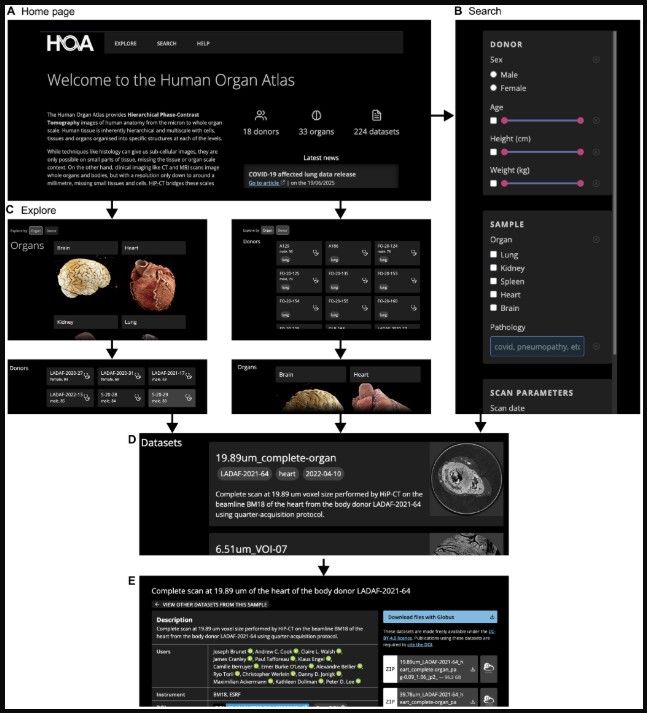
(A) The HOA home page with tabs for different pages listed across the top. To discover datasets, users can either go to (B) the Search tab to search based on medical, scan, and demographic metadata or go to (C) the Explore tab. Within the Explore tab (C) datasets can be ordered first by organ (C), left column or by donor |(C), right column]. From both Search and Explore tabs, the user is then presented with (D) a list of datasets and, when one dataset is chosen, is taken to (E) the dataset page with in-browser visualization and download options for the various downsampled datasets and metadata.
The 3D Atlas can be accessed here;
https://human-organ-atlas.esrf.fr
Sources;
 Scriveners Online©