There has always been and likely will continue to be a number of different programs of schools of medicine that compete, sometimes fiercely. Indeed, one might think that these schools derive from completely different universes. As they did not, there is nothing fundamentally different about a patient who sees an allopathic physician from one who sees a homeopath.
It is not like allopathic medicine and homeopathy decided to divide the different diseases humans are heir to and so the patients similarly segregated themselves. Allopathic medicine has become so dominant since the Flexnerian revolution in the medical education in the early 1900s that it is hard for many to appreciate that there are differing approaches. However, this many only appear so to allopathic doctors of medicine (MDs) and osteopathic medicine (DOs) as there is a vast underground of patients acting as their own herbalists, and chiropractic continues unabated, if only through tradition and anti-discriminatory laws. Thus, there continues to be strains of alternative approaches to traditional allopathic medicine, and many of these previously alternative approaches are finding their way into allopathic medical practice.
The question becomes: What is the epistemic biases for the different approaches, and why has the division been impossible to maintain sharply? The argument here is that all clinicians faced the same epistemic question, which is how to make sense of the individual patient given the great diversity among patients.
Furthermore, medicine is forced to dichotomize: Is there or is there not a disease? The question for every clinician is how to make sense of it all despite the bewildering variations in human health and disease.
Ascendency of Allopathic (Scientific) Medicine
The Flexner Report (Flexner, 1910) dramatically reshaped medicine in North America. Ostensibly, an evaluation of medical education with recommendations ultimately led to the closure of nearly half of the medical schools in the United States. Those remaining did so by allying with universities – mostly for financial necessity rather than by force of medical knowledge. In so aligning, the majority of medical schools fell into the allopathic traditions. With education being a critical requirement of medical licensure, the allopathic physician acquired great power.
Many medical schools teach diseases proceeding first from the principles, particularly pathology. Indeed, it may be well that histopathology, derived from cell theory in the mid-1800s and the clinical-pathological correlations of Sir William Osler (1849-1919), did the most for allopathic medicine’s triumph over its competitors and shaped allopathic medical education to this day. Most courses are organised according to organ systems, with the typical trajectory beginning with the normal structure of organs, to their alteration in disease, and then finally to the symptoms and signs associated with the disease.
To be sure, the pedagogy is changing from a traditional 2 years of basic science followed by clinical apprenticeships to a problem- or case based education. Nevertheless, the ontological presuppositions and epistemology approaches largely remain the same.
Dichotomization Based on Statistical Significance
In science, as in medicine, experiments are arguments constructed of premises and prepositions cast in scientific form. They produce results that are dichotomized under two category headings – statistically significant and not statistically significant – according to consideration of their p value, for example, which is the probability that any detected difference or result in an experiment is due to chance.
The Inverse Problem
Clinicians must, at least initially, reason from symptoms and signs to the pathological conditions in order to diagnose and treat. Typically, there is not a one-to-one correspondence between a set of specific symptoms and signs and a specific diagnosis. It is rare for a set of specific symptoms and signs to be pathognomonic of only a single pathological process; hence the need for further considerations, particularly a generation of differential diagnosis.
Epistemically, the lack of one-to-one correspondence between sets of symptoms and signs and the diagnosis relates to the inverse problem that arises when there is a single mechanism that mediates the expression of multiple causal factors. These factors may be parallel yet converge onto the common final pathway mediating expression, or the factors can be successive or sequential. An automobile may not start for any number of reasons, and the automobile just sitting there does not specify the exact cause. Clinicians recognize, if only tacitly, the inverse problem in the admonition of practical reasoning to entertain a differential diagnosis. Most clinicians approach the possible treatments in a more or less sequential fashion, recognising that if multiple changes are made simultaneously, it will be difficult to attribute the exact cause of improvement or an adverse effect.
Sorting through the differential diagnosis risks error because of the Fallacy of Confirming the Consequence and the Fallacy of Limited alternatives and its probability counterpart, the Gambler’s Fallacy.
Fallacy of Confirming the Consequence – it is of the form if a implies b is true, then a is true. The problem with the fallacy is that b could be true of any number of reasons other than a.
Gambler’s Fallacy – originallly, a fallacy in which past occurences are thought to affect future occurences of events that are independent. For example, a gambler might believe that his luck has been so poor previously that he due for a win. Alternatively, a gambler on a winning streak believes that he will continue to win. In this book, the concept of gambler’s fallacy is extended to diagnosis.
The Gambler’s Fallacy may occur when the demonstration of one cause seems to affect the likelihood of other causes. Frequently, when confronted with a patient with a peripheral neuropathy and a known diagnosis of diabetes mellitus, the physician quickly attributes the peripheral neuropathy to the diabetes and does not look for other causes. However, there may be nothing about the patient having diabetes mellitus that reduces the probability of an alternative diagnosis, assuming the probability of each alternative is independent of the other. If indenpendent alternative diagnoses, such as autoimmune disorders, are appropriate in the absence of diabetes mellitus, they are just as appropriate for consideration in the presence of diabetes. The pursuit of alternative diagnoses depends on factors independent of the presence or absence of diabetes mellitus.
Historical Approaches to Diagnosis
For the empirics engaged in homeopathy, the approach was to match the symptoms and signs to the effects of various treatments. Their motto was similia similibus curantur (“like cures like”). Those treatments with effects that most matched individual patient’s symptoms and signs provided the diagnosis. But the diagnosis was highly idiosyncratic to the individual patient, which allowed no introduction to general principles for which some economy of explanation could be achieved. Interestingly, the inverse problem was avoided. There were as many diagnoses as there were patients.
Rationalistic/Allopathic physicians believed that disease could be understood based on economical set of fundamental mechanisms that would be combined to understand the patient’s symptoms and signs. Treatments were then based on the identified fundamental mechanisms. “By an economical set of fundamental mechanisms,” I mean that the number of principles necessary to explain health and disease in humans is sufficiently fewer than the number of humans. Nevertheless, infinity by recursion from the finite allows an explanation of the variety of patient manifestations just as an effectively infinite number of English language texts are possible using 26 letters, spaces and punctuation marks. However, the rationalist/allopathic physician took on the inverse problem. The consequence of that fateful choice to the epistemic question has enormous repercussions, which will be explored throughout this text.
Medicine and Science
Medicine has had a long complicated relationship with science. There is the temptation to consider modern medicine as synonymous with modern medical science. However, that would only be a recent invention and only questionably true. Allopathic medicine has been shown since the Greeks, at least as represented by the works of Galen which were derived from the physics and metaphysics of Aristotle. Aristotle was a keen empirist but also a rationalist, materialist, and reductionist.
The mid-1800s was a remarkable time in the history of medicine. Early in the century, a number of alternative medical paradigms challenged the rationalist school. The secong half of the century found these alternatives dramatically weakened and relegated to a fringe, for better or worse. The new mainstay medicine, also called regular, allopathic, or rationalist, would become essentially unchallenged. As will be seen, the reason for ascendency of regular or allopathic medicine ad little, if at all, to do with its greater benefit to the patient, but rather was political and affected under the guise of educational reform. To be sure, allopathic medicine would be vindicated by modern medicine, but this was not the case when allopathic medicine became dominant.
The questions become: How did allopathic medicine differ from its competitors, and how does this relate to the approach to knowledge?
Diagnosis and Treatment
The priviledge of diagnosis was ardently defended as reserved for physicians. Apothecarists were prohibited from making diagnosis, although the apothecarist would compound the various treatments prescribed by the physician. Indeed, apothecarists could not bill patients for any diagnosis they rendered in the course of providing elixirs, poultices, and plasters. The Rose Case in England (1701-1704) allowed apothecarists to diagnosis in the course of their preparing treatments, although they could not bill for the service; diagnoses for fees were reserved for physicians.
Evolution of Medical Sciences
Galen’s inferences from observations were to qualities of moist versus dry and hot versus cold. As can be seen in the figure below, these qualities were related to the four Aristotelian elements: earth, fire, water, and air. Furthermore, these elements were related to the four seasons and to the four humors. The association of these items were very important. For example, the conjunction of air, moisture and the spring season figured very prominently in the diagnosis of yellow fever by Benjamin Rush (1746-1813). Yellow fever is due to the transmission of viral infection by Aedes aegypti mosquitoes, which are most prevalent in wet seasons, such as the spring. Another, although often overlooked concept, Galen borrowed from Aristotle is the latter’s notion of contraries – moist versus dry and hot versus cold. Aristotle held that all entities were a mixture of the two extremes.
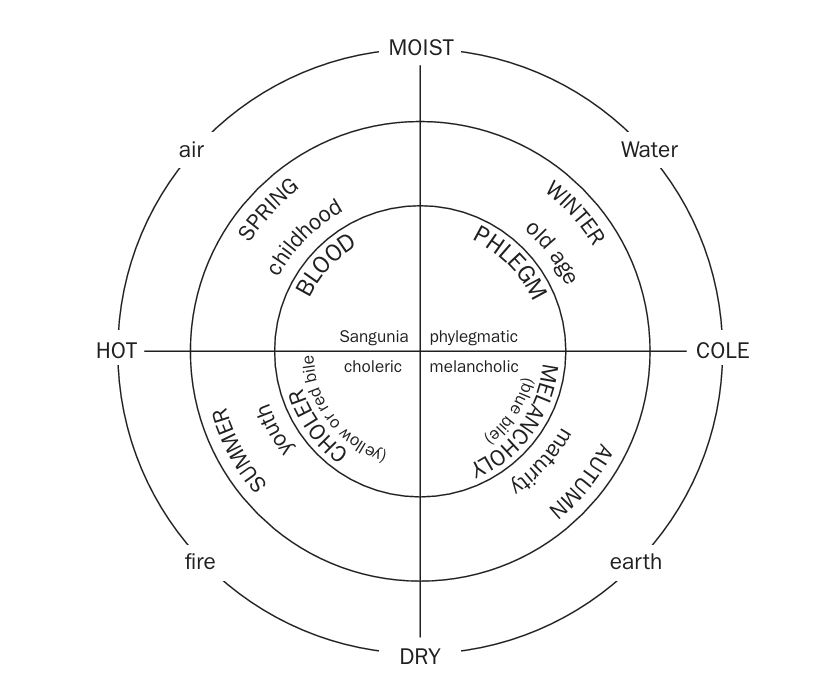
Dichotomizing forces and entities achieve a great economization of underlying mechanisms and principles; hence its attraction to scientists, philosophers, and allopathic physicians.
Instituionalization of Scientific Medicine and Further Reinforcement of Abduction
While allopathic medicine may have taken on the mantel of science, it is not exactly clear that this constituted a superior medical method; certainly, at the time, there was no serious advantage to their scientific medical method because treatments for the most part were similar to those of the empirics who the allopathic physicians railed so against. In the early 1800s, the number of homeopathic practitioners nearly equaled to those of allopathic physicians. The key to undoing the political victory by the empirics in the United States would come from educational reforms consequent to the 1910 Flexner Report to the Carneige Foundation (Flexner, 1910).
The report presented on the status of medical education in North America and found medical education wanting. The consequence was a subsequent closing of nearly half the schools of medical education, and those that remained were predominantly allopathic medical schools. The remaining schools alliliated with universities, primarily for financial reasons and attempting to cash in on the largess of the Gilded Age.
Many argued that the Flexner findings were preordinated as there was a strong move among allopathic medical schools to model the German schools of the 1800s, probably in no small manner related to the remarkable advances in the German histopathological understanding of disease.
A Different Notion of Sciences
While allopathic physicians claimed science, the empirics seemed to have resembled more of the Baconian notion of science than that of the allopathic physicians who claimed to be more scientific. Cartesian science was its alternative form of science. It is a science that fails to provide new knowledge and at its best merely discovers knowledge that is implicit in the premises and propositions.
Variability versus Diversity
Variability between specific phenomena implies some relationship among the individual phenomenon; diversity implies none or at least less. Variability will refer to the notion of an archetypical or canonical form, such as the central tendency in a satistical distribution, where each instantiation represents a variation on the archetypical or canonical form. Diversity would be construed as differences between instantiations without an archetypical or canonical form. In diversity, each instantiation is taken as de novo.
The Human Epistemic Condition
This presentation centers on the distinction between variability and diversity in natural philosophy and science, particularly medical science. In many ways, it is an epistemic device in which the metaphysical predisposition is to invoke variability or diversity in the absence of compelling evidence to choose one or the other.
In medicine, this epistemic condition resulted in a relatively sharp distinction between the empiric/irregular physicians and the rationalist/allopathic/regular physicians. It was not until the early twentieth century that evidence finally favoured the rationalist/allopathic/regular medicine. This same epistemic condition is also evident in the transition from natural philosophers to modern scientists, particularly experimentalists.
The epistemic condition is even more basic or fundamental. In physical systems, there is a significant challenge to differentiate what is random behaviour from what is determinant behaviour. One could hold the random phenomena akin to diversity, while determinant bahaviour is more akin to variability…
Wired for Intuition?
Clearly, there are physicians who make valid inferences seemingly out of nowhere. In other words, intuitions do not appear to follow from a logical chain of reasoning where each step is to explicated. In this sense, the best definition of medical intuition is what intuition is not. Plato made the distinction between perceptions that are “given” and those that are “intellected.”
(Basically, for the most of medical reasoning there’s probability of gains and odds! What have you gained from today’s book reads????) 😉
Sources & Credit
Medical Reasoning
THE NATURE AND USE OF MEDICAL KNOWLEDGE
ERWIN B MONTGOMERY JR
The Oxford Handbook of Epistemology (2002)
 Scriveners Online©