




Excerpts from the Meddygon Myddvei
Meddyginiaeth, or mediciDe, numbers as one of “the nine rural arts, known and practised by the ancient Cymry before they became possessed of cities and a sovereignty ; “* that is, before the thne of Prydain ab Aedd Mawr, which is generally dated about a thousand years anterior to the Christian era. In that remote period the priests and teachers of the people were the Gwyddoniaid, or men of knowledge, obviously so called from their being looked upon as the chief sources and channels of wisdom in the land. It is to these men that the art of healing is attributed, which they seem to have practised mainly, if not wholly, by means of herbs. Indeed Botanology, or a knowledge of the nature and properties of plants, is enumerated as one of the three sciences, which primarily engaged their attention — the other two being Theology and Astronomy, as appears from the following Triad : —
”The three pillara of knowledge, with which the Gwyddoniaid were acquainted, and which they bore in memory from the beginning : the first, a knowledge of Divine things, and of such matters as appertain to the worship of God, and the homage due to goodness ; the second, a knowledge of the course of the stars, their names and kinds, and the order of times ; the third, a knowledge of the names and use of the herbs of the field, and of their application in practice, in medicuie. and in religious worship. These were preserved’ in the memorials of vocal song, and in the memorials of times, before there were Bards of degree and chair.”





But among the Cymry all branches of knowledge were centered indiscriminately in the Gwyddoniaid until the time of Prydain. These in his reign were divided into three orders, Bards, Druids, and Ovates, each having its peculiar duties as well as privileges. It was to the Ovate more especially that the studies and application of terrestrial and natural sciences, such as the one which now engages our attention, were entrusted.
On the contrary, the classical writers of Greece and Borne, as soon as they are in a position to address us, bear witness in a greater or less degree to the same fact, and support the general correctness of our traditions. The physical researches of the Bards and Druids seem to have caught their especial attention. “The soothsayers,” says Strabo, “are sacrificers and physiologists (0i;<rto\o7o«.) The Druids in addition to physiology practise ethic philosophy.” Nature both external and human — causes and eflfects— diseases and their antidotes — all came under their cognizance, and in their hands underwent a complete and practical investigation. Cicero informs us that he was personally acquainted with one of the Gallic Druids, Divitiacus the ^duan, a man of quality in his country, who professed to have a thorough knowledge of the laws of nature, including, as we may well suppose the science of medicine.
Pliny enumerates some of the plants most in repute among the Britons for their medicinal properties. He mentions the mistletoe, and observes that in Druidical language it signified *^ All heal,” omnia sanantem — a name indicative of the efficacy which it was supposed to possess; and it is remarkable, as corroborative of his assertion, that OU iach is to this very day one of the names by which the plant in question is known to the Cymry. Nor does it appear that its virtues, real or traditionary, were forgotten in comparatively recent times. In the Book of Howel Veddyg, a descendant of the celebrated physicians of Myddvai, and which forms the second part of the present volume, we are informed that the mistletoe was efficacious in cases of general debility — nervous complaints — brain fever — rheumatism — affection of the heart, liver, bowels, kidneys, spine-^ epilepsy — ^paralysis — insanity. It will strengthen the sight and hearing, and all the bodily senses — prevent barreness — and ” whosoever takes a spoonful of the powder in his ordinary drink once a day, shall have uninterrupted health, strength of body, and manly vigour.”
Taliesin has likewise the credit of being the pro-
pounder of the following medical Triads;-
“There are three intractable substantial organs: the liver; the kidney; and the heart.
There are three intractable membranes: the dura mater; the per-itoneum: and the urinary bladder.
disher of te thre tedious a i and phias if the encutient
matter has formed in one of these, it is not known when it will get well.”+
The period between the 6th and 10th centuries, being especially occupied with national troubles, does not seem to have been favourable to the study of the arts and sciences in Wales ;—at any rate the literary remains of that interval are extremely scanty, and furnish us with no information as to the state of medical science, or the estimation in which the physician was held in the country.
The period between the 6th and 10th centuries, being especially occupied with national troubles, does not seem to have been favourable to the study of the arts and sciences in Wales ;—at any rate the literary remains of that interval are extremely scanty, and furnish us with no information as to the state of medical science, or the estimation in which the physician was held in the country.
Not so, however, the era of Howel Dda, (or the Good.) In his laws, which were compiled about A.D. 930, several particulars are noticed in connexion with
these points, and more especially the mediciner of the Royal Court. Of him it is thus stated :—
” Of the mediciner of the household, his office, his privilege, and his duty, this treats,
- The twelfth is the mediciner of the household.
- He is to have his land free; his horse in attendance; and his
linen clothing from the queen, and his woollen clothing from the king.
- His seat in the hall within the palace is at the base of the pillar to which the screen is attached, near which the king sits.
- His lodging is with the chief of the household.
- His protection is, from the time the king shall command him to visit a wounded or sick person, whether the person be in the palace or out of it, until he quit him, to convey away an offender. pal. e, a i to adhi or me doine grat, usle is to have hot the from them except their bloody clothes, unless it be for one of the three dangerous wounds, as mentioned before; these the head unto the brain a stroke in the body unto the bowels; and
the breaking of one of the four limbs; for every one of these three
dangerous wounds the mediciner is to have nine score pence and his food, or one pound without his food, and also the bloody clothes.
- The mediciner is to have, when he shall apply a tent, twenty four pence.
- For an application of red ointment, twelve pence.
- For an application of herbs to a swelling, four legal pence.
- For letting blood, four pence.
- His food daily is worth one penny halfpenny.
- His light every night is worth one legal penny.
- The worth of a medical pan is one penny .
- The mediciner is to take an indemnification from the kindred of the wounded person, in case he die from the remedy he may use, and if he do not take it, let him answer for the deed.
- He is to accompany the armies.
- He is never to leave the palace, but with the king’s permission.
- His saraad is six kine, and six score of silver, to be augmented.
- His worth is six score and six kine, to be augmented.”
If the mediciner was insulted while inebriated he was not entitled to saraad, as ” he knew not at what time the king might want his assistance.”
He was ” firee to travel the road, and out of the road — along with the messenger of the sick,” and, as stated in legal fragments entitled ” Elucidation,” any one might take another’s horse to procure a medical man for a person in danger without being required to make amends.
We have no reason to suppose that there was any material difference either in the position of the physicians, or in the attention paid to the study of medicine during the succeeding ages, until we come to the era of Rhys Gryg, when the Physicians of Myddvai flourished.


Rhys Gryg II was the son of Rhys ab Gruffydd, prince of South Wales, and lived in the former part of the 18th century. He was a distinguished warrior, and fought with varied success in the wars which were carried on in Wales almost without intermission during his life. According to old usage he had his domestic Physician, namely Rhiwallon, who was assisted by his three sons, Cadwgan, Gruffydd, and Einion, from a place called Myddvai, in the present county of Caermarthen, whose rights and privileges, as enjoined by law were worthily maintained and upheld by the prince. Under his patronage these men made a collection of valuable medicinal recipes applicable to the various disorders to which the human body was then subject. But though this collection bears their name, we are not to suppose that all the prescriptions contained therein were the result of the studies and experience of the Physicians of Myddvai. Some no doubt had been in the materia medica of Wales long before ; a few indeed may perhaps be traced up to the time of Howel the Good, if not to the sixth century. Such, however, do not seem to have been reduced to writing, until the Physicians of Myddvai took the matter in hand, and produced the work, which is now for the first time printed. The original manuscript is supposed to be the one lately transferred from the library of the Welsh Charity School, in London, to the British Museum. Of this there are several copies ; the one adopted as the basis of the present volume is from the Red Book, in Jesus College, Oxford, which was carefiiUy collated by the Rev. Robert Owen, B.D., Fellow of the said College, with a transcript made by the late Mr. Saunders, from Mr. Rees of Tonn’s copy; which MS. was, moreover, copied about 1766, by William Bona, of Llanpumsant, from another belonging to lago ap Dewi of Llanllawddog. The various readings of the Tonn copy are all arranged at the foot of each page, and referred to under the letter T.
A knowledge of medicine was preserved in the descendants of this femilj, and they continued to practice as physicians at Myddvai, without intermission, until the middle of the last century.
The second portion of this volume purports to have been compiled by Howel the Physician, son of Rhys, son of Llewelyn, son of Philip the Physician, a lineal descendant of Einion, the son of Bhiwallon, from the Books of the first Physicians of Myddvai. William Bona made a transcript from the Book of John Jones, Physician of Myddvai, the Jast lineal decendant of the family, a.d. 1743. The late lolo Morganwg took a copy of this MS. in 1801, and it is his copy, now in Llanover Library, that forms the text of our volume.
Besides these collections, several fragments, some indeed of considerable lengths, but of uncertain date, may be often met with in MSS. having for the most part, perhaps, been made by individual practitioners for their own private use, before the art of printing became general. Some medical prescriptions assumed a proverbial shape, and in that form clung firmly to the public mind. We subjoin a few of these ; and as proverbs loose much of their point when translated, we give them first in their original form.
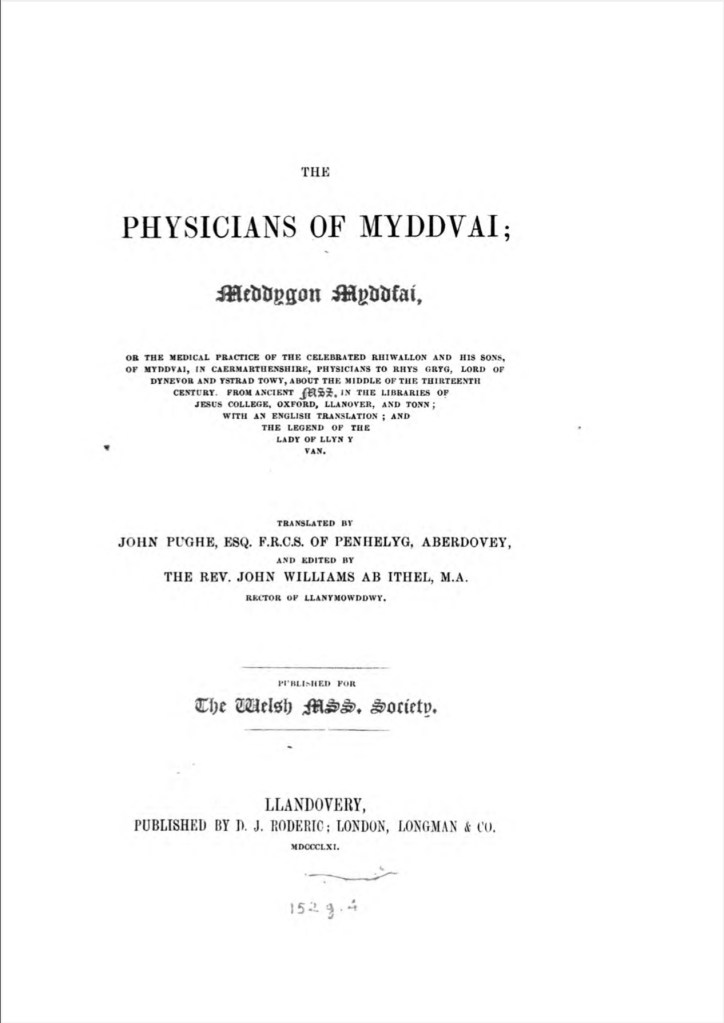
THE PHYSICIANS OF MGDDAI
INTRODUCTION.
§ 1 . Here by the help of God, the supreme chief Sovereign, are shewn the most notable and principal methods of healing the human body, the persons who caused them to be written after this fashion being Bhiwallon the Physician, and his sons, even Kadwgan, Griffith, and Einion. For they were the ablest and most eminent of the physicians of their time, and of the time of Rhys Gryg ^ their lord, and the lord of Dinevor, the nobleman who maintained their rights and privileges, in all integrity and honour, as was meet. The reason why they thus caused a record of their skill to be committed to writing was, lest no one should be found after them so endowed with the requisite knowledge as they were.

THE HEAD.
§ 2. The head is the first and the most important portion of man^s body, which God formed, for therein are the five corporeal senses.
ORIGIN OF DISEASES IN THE HEAD.
§ 3. Diseases originate in three places in the head ; one is the pericranium, the second is the cranium, and the third is the dura mater.
PRESERVATION OK THE CRANIUM AND SCALP.
§ 4. 13y an incision in the scalp, extending to the cranium, and giving exit to the venom, is the cranium preserved. 13y phlebotomy and cauterization is the scalp preserved.
DURA MATER.—TUEATMENT.
§ 5. By exposing the dura mater, taking two parts of wood betony, and three parts of the violet, with salt butter, ])Ounded together, and applying them thereto, the venom is removed from the dura mater. It will extract any inflammation and pain existing therein.
DURATION OP TREATiMENT.
§ 6. From the time the scalp is laid open to the end of nine days, shall this issue remain on the bone : that is to say, this plan should be followed in an old standing complaint of the head.
WOUND ON THE HEAD.— TREATMENT, PHYSICIAN^S FK::.
§ 7. As to a recent blow or fresh wound on the head, tlie sooner it is dressed the better, lest there should be extravasated blood upon the dura mater, and that it should become concocted there. When the bone and the dura mater are exposed, take the violet and fresh butter, and pound together. If the violet cannot be gotten, take the white of eggs and linseed, pounding tliein together ; or fresh butter and linseed, and apply thereto till (the pain is) assuaged. Then an ointment should be prepared of herbs, butter and tallow, and applied thereto until it is cured. A pound is the physician’^s fee for this treatment as regards the deed of mercy simply^ without victuals : or nine score (pence) with victuals.^
PNEUMONIA.— TREATMENT.
§ 11. There are three kinds of lung disease ; — simple pneumonia, white pneumonia, (bronchitis) and black pneumonia, (phthysis) which is mailed by pain below the mammas, under the armpit, and in the top of the shoulders, with (hectic) redness of the cheeks. And thus are they
treated. Let (the patient) take, for three successive days, of the following herbs ; hemlock, agrimony, herb Robert, and asarabacca, then let him undergo a three day^s coarse of aperients. When the disease is thus removed from the bronchial tubes, an emetic should be given him (daily) to the end of nine days. Afterwards let a medicine be prepared, by digesting the following herbs in wheat ale or red wine : madder, sharp dock, anise, agrimony, daisy, round birthwort, meadow sweet, yellow goat’s beard, heath, water avens, woodruff, crake berry, the com cockle, caraway, and such other herbs as will seem good to the physician.
Thus is the blessed confection prepared. Take of May butter, a she-goat’s suet or a doe’s fat, the shepherd^s needle, and as many as may be desired of such herbs as may be suitable for the purpose. A wounded lung is the physician’s third difficulty, for he cannot controul it, but must wait for the will of Grod. By means of the herbs just mentioned,* a medicine may be prepared for any one who has a pulmonary abcess (empyema.) He should let out (the matter) and support (the patient) as in the case of a wounded lung, till he is recovered. But most usually, he will have died within eleven years (al. one year.)
FEVERS.
§ 12. There are four kinds of fevers, deriving their origin from the summer, viz. latent fever, intermittent fever, ephemeral fever, and inflammatory fever. The fifth fever is typhus, and this kind proceeds from the brain. A latent fever is relieved by an emetic, a cordial, and cauteries. Thus it originates ; from the over generating of tough humor in the stomach, from which results a distaste for food, and lassitude during summer. The mugwort, madder, meadow sweet, milfoil, hemp, red cabbage, and the tutsan, all these seven herbs enter into the composition of the medicine re- quired. Whosoever obtains them all, will not languish long from a wounded lung, or need fear for his life. Any of the following herbs may be added thereto, butcher’^s broom, agrimony, tutsan, dwarf elder, amphibious persicaria, centaury, round birth wort, field scabious, pepper mint^ daisy, knap weed, roots of the red nettle, crake berry, St. John’*s wort, privet, wood betony, the roots of the yellow goafs beard, heath, water avens, woodruff, leaves of the earth nut, agrimony, wormwood, the bastard balm, small burdock, and the orpine.
INTERMITTENT FEVERS. TREATMENT.
§ 13. For intermittent fevers. Take dandelion and fumatory, infused in water, the first thing in the morning. Then about noon take wormwood infused in water likewise, drinking it as often as ten times, the draught being rendered tepid. Let bread made with pounded wheat be also taken, or oaten cakes^ goafs whey, the flesh of a young fowl, husky porridge in water, milk being abstained from, and indeed every kind of milk diet. If the ague does not then terminate, the patient must be put in a bath, when the paroxysm comes on, and an emetic given him whilst in the bath, as it will then act more powerfully.
COOLING DRINKS.
§ 14. The three best cooling drinks are apple water, goafs whey, and spring water.
INTERMITTENT FEVERS.
§ 15. Another treatment for an intermittent fever. Take the mugwort, dwarf elder, tutsan, amphibious persicaria, pimpernel, butcher^s broom, elder bark, and the mallow, and boiling them together as well as possible in a pot, or cauldron. Then take the water and herbs, and add them to the bath. The following is a good medicine for this class of diseases : take moss, ground ivy, or elder, if obtainable, (if not obtainable, caraway,) and boil these two vegetable substances well together. Then take the mallow, fennel, pimpernel, butcher^s broom, borage, and the young leaves of the earth nut, and bruise them as well as possible, putting them on the fire with the two herbs before mentioned, and boiling them well. This being done, let elder bark be taken from that portion of the tree which is in the ground, let it be scraped and washed thoroughly, and bruised well in a mortar. Then take the liquor prepared from the forementioned herbs, and mix the said bark therein assiduously between both hands, and set it to drain into a vessel to acidify, fermenting it with goa^s whey, or cow’^s whey. Let a good cupful thereof be drank every morning as long as it lasts, a portion of raw honey, apple or wood sorrel, being taken subsequently in order to remove the taste from the mouth, after the draught. This liquor is beneficial to every man who requires to purge his body.
HEMORRHOIDS.^EXCITINQ CAUSE. TREATMENT— SURGICAL. ANOTHER METHOD.— MEDICAL. FORBIDDEN FOOD.
§ 16. There are two kinds of hemorrhoids, humoral hemorrhoids and inflamed hemorrhoids, the latter produced by summer heat, the former by summer moisture^ when either condition prevails. It is in this manner that it comes. Four veins proceed from the liver to the anus ; therefore, thus it may be cured. Secure three of these by means of a ligature, and let the fourth be left free. The cautery also should be applied to the ancles, and about the knees and hams. Thus the blood will be habitually diverted to the lower extremities, when the cauteries shall have discharged all the humor from the vein.
The second plan of treatment is as follows. Take the mallow, and boil it in wheat ale, or in spring water. Then take that which grows in the earth of the elder (bark,) bruise well in a mortar, and mix it, crude as it is, with the above mentioned decoction, and administer it quickly to the patient, so as to act upon his bowels. Let him afterwards be forbidden beef, cheese, leeks, large fish, salmon, eels, ducks, garlic, and all kinds of milk diet, except whey made with warm milk (from the cow.)
PROFUSE MENSTRUATION.— TREATMENT.
§ 21 . A woman who is subject to profuse menstruation, should take the reddish bastard balm, small burdock, orpine, stinking goose foot, pimpernel, water avens, with the ashes of a harf s horns, that has been killed with his antlers on, boiling them, as well as possible in red wine, straining the liquor carefully, and drinking it daily, till it is finished, abstaining (the while) from stimulating food. Being restrained by the above means, the blood will be habitually diverted to the thighs and ancles.
A PUNCTURED WOUND,
§ 37. For a punctured wound. Take the dung^ of a bull, apply thereto, and it will be healed.
BITE OP A SNAKE.— ANTIDOTES FOR. ANOTHER WAY.
{ 1 10. For the bite of a snake. Drink the juice of the greater plantain, with oil and salt. The juice of the mugwort also, when bruised and strained will neutralize poison.
Another way is to take the brains of a red cock and rue ; mix with sweet milk, curdled milk or wine, and drink. Take also of the flesh of the breast whilst warm, (the cock being alive,) and apply to the wound. It will extract the venom.
VOMITING AND SIGHING.— A REMEDY.
§ 130. For vomiting and sighing. Mix a handful and a half of betony in warm water, and drink it.
To cure vomiting, take betonica, and boil in honey, pounding in a mortar, and form into four balls, and administer to him one daily as a drink, in a warm potion.
URINAL PATHOLOGY^POUR URINARY ELEMENTS.*
§ 140. From the condition of a man^s urine, may be distinguished his defects, dangers, fevers (plagues,) and diseases, whether he be present or absent. However, we should first show what is the composition of the urine. It contains four radical elements.
Firstly The humor of the blood which circulates in the reproductive organs.
SECONDLY. That of the abdominal viscera, for the performance of the functions thereof.
Thirdly. That of the vessels which receive the varions fluids of the cholera and fleuma (bile and phlegm).
Fourthly. That of the kidneys, supplying those fluids which pass to the bladder. From hence can be discerned all the signs of disease, the fluidity and colour of the urine indicating the evil and good signs.
URINAL DIAGNOSIS.
§ 141. Should urine abound in water, or resemble red, bhtck, or green wine, or oil, or blood, or the urine of beasts, and a skilful person consider the essential causes thereof, attentively studying the same, he will understand which of these humors chiefly predominate, whether the fleuma, the cholera, the sanguis, or the melancholia. It is necessary that the urine be collected in a glass vessel, and left to settle till the second hour, when, by the light of the sun, the physician should judge the indications thereof.
THREE THIN INCURABLE ORGANS.
§ 153. There are three thin incurable organs ; the pia mater, small intestines, and bladder. They are incurable for the same cause as the others.
SWELLING AFTER INJURY.— REMEDY.
§ 162. For a swelling, the result of an injury. Take the juice of the yellow bed straw, the juice of the plantain, rye meal, honey and the white of eggs. Make into a plaster, and apply thereto.
BOILS.
§ 163. For boils. Take the juice of the morella (mushroom,) plantain, barley meal, and the white of an egg.
DIGNITY OF MEDICINE.
§ 171. Let all men know that it will be vain to seek anything except by effort. There can be no effort without
health ; there can be no health without temperance in a man^s nature, and temperance cannot exist in a man^s nature without -moderate heat in his extremities. God has decreed a supervision of the manner in which we should conserve the health, and has revealed it to his own servants, the philosophers and chosen prophets, who are full of the Holy Spirit, and whom God ordained to this profession.
MODERATION.
{174. The philosophers have said whosoever shall eat or drink more or less than he should, or shall sleep more or less, or shall labour more or less from idleness or from hardship, (being obliged to over exert himself or who, used to being bled, refrains from doing so, without doubt he will not escape sickness. Of these things we shall treat presently, and of what is most suitable for our use.
SAYINGS OF THE WISE AS TO FOOD. 5 176. Wise men have declared, whosoever refrains from eating or drinking immoderately, and will only partake tem-perately oMood and drink, as his constitution requires, shall enjoy health and long days, that is, a long life. Philosophers never said anything to the contrary. Desire, love, and the reception of worldly honour, these things fortify and assist life, so that they be gratified temperately. On which account, whosoever desireth life and permanence, let him seek that which is permanent and tends to prolong life.
EAT SLOWLY AND SPARINGLY.— MEN OF ARABIA.— TWO ♦ RULES TO PRESERVE HEALTH.
§ 177. Whosoever, restraining their appetite, refrain from gluttony, and eat slowly, these shall live long ; which may be thus proved. The men of Arabia, who dwell in mountains and pathless woods, are the most long lived (of mortals,)
as these circumstances prevent excessive eating and drinlcing. The health may be preserved in two ways. First, — that is, by partaking of such food as is most suitable to the time of life and the constitution, restricting himself to that sort of diet which he was reared upon. Secondly, — by evacuating duly, what is poured into the stomach from above.^
INTRODUCTION.
The following Work is a book of remedies, which have been proved to be the best and most suitable for the human body, through the research and diligent study of Bhiwallon the Physician, and his three sons, even Gadwgan, Griffith, and Einion, who were Physicians to Ehys Oryg, ab Griffith ab Bhys ab Tewdwr, their Lord, who gave them rank, lands, and privileges at Myddvai, for their maintenance in the practice of their art and science, and the healing and benefit of those who should seek their help.
Herein, therefore, by the help of God, is exhibited the art of heaUng the injuries and diseases to which the human body is most subject, and the method of their management.
In the name of the Father, of the Sox, and of the HotY Ghost. Amen, and so may it ever be.

FLATULENT DYSPEPSIA.
§ 1. Take parsley seed, bruise well, and boil in the juice of the same. Let it be drank warm, the pain being present.
TO BREAK AN IMPOSTUME OR ABSCESS. § 6. Take a small portion of the herb called the herb of grace,f a portion of leavened bread, and half a spoonful of glue, boil these ingredients in the sediment of old ale, mixing them well together until the mass thickens; when required for use let it be applied hot to the impostume.
FOR THE TOOTHACHE.
S 7. Take distilled water of red roses, a small portion of beeswax, and a little fresh butter, say an equal quantity of each; let the ingredients be mixed together in a dish upon embers, then let a linen cloth be dipped therein, and applied to the affected jaw as hot as it can be borne.
OINTMENT FOR AN ULCER.
S 8. Take four portions of rosin, two of wax, one of lard, and four of verdigris; let these ingredients be boibd
♦Half a Pint †Rue.
together on a slow fire, and strained through a coarse cloth. It should be kept in a well covered leaden vessel.
FOR ALL KINDS OF ACHES.
§ 9. Take linseed, boil in milk, and apply to th^ painful part.
TO HEAL A WOUND.
§ 10. Take yellow wax, melt on a slow fire, and take bruised cummin seed, mix with the molten wax, then stir these ingredients with a stirrer until cold. Apply this as a plaster to the wound.
TO PRODUCE A DIURETIC EFFECT.
§ 23. Take some haws, put them in a vessel of red earths enware, mix therewith a good quantity of honey, then put in an oven with bread ; of this take four spoonfuls three times a day.
FOR A MALIGNANT SCALD OR RINGWORM.
§ 27. Take some snails and prick them all over with a needle till a kind of water exudes from them, and with this water wash the scald or ringworm, then bind some honeysuckle leaves on the part ; let this be done night and morning, and in a short time you will be cured.
2 R
FOR A HCEMOPTYSIS, THE CONSEQUENCE OP THE RUPTURE OF A BLOOD VESSEL IN THE LUNGS.
28. Take the dung of mice and dry in the sun, or at a distance before the fire, then powder ; let as much as will stand on a groat be put in half a wineglass of the juice of the plantain mixed with some burnt honey, and let the patient drink thereof night and morning, continuing this treatment till he is cured.
FOR A HEADACHE.
§ 40. Take a piece of raw beef, and lay it on the nape of the neck, taking it away each night in going to bed ; do this as often as needful. It is proven.
FOR THE GOUT.
§ 41. This disease is mostly confined to the feet and hands. Take wood sage, pellitory of the wall, wheat bran, cow’*s dung, and salt, boil together in wine or cider vinegar, and apply as a plaster to the painful part.
TO MAKE A PLASTER FOR ALL KINDS OF ACHES.
§ 42. Take a pound of crude wax, half a pound of rosin, one sixth of a pound of thus, and a pound and a half of ram’^s suet, boil together and strain into a clean basin, then place the basin on a cinder fire in ^ stove ; saturate a piece of linen in this, and apply to the’ painful part.
FOR A COUGH.
§ 43. Take mustard seed coarsely powdered, boil with some figs in strong ale, and drink.
FOR HOEMATURIA.
§ 58, Take agrimony, bruise well, and mix the mass with wine, ale, or mead to drink, and you will obtain a cure.
FOR A DIARRHOEA.
S 59. Take the roots of the red fennel, (pyrethrum inodarum) pound in a mortar well, and mix with goafs milk, drinking for nine mornings ; it will be of benefit, and stay the purging. It is proven.
FOR DYSPNCEA IN THE C^EST.
§ 61. Seek the roots of the elecampane, wasjh clean and scrape, then boil in white wine vinegar when scraped. Dry them, reduce into powder, and boil the powder in honey, and add powdered pepper thereto ; keep in a box and take a spoonful night and morning. This will cure the patient.
If there is dyspnoea and cough with expectoration in a person, seek three cinders and set before the sick^person, then let him spit upon the cinders ; if the expectorated matter smells offensively he will die, if not he will recover.
FOR A SPRAIN.
§ 79. Seek the lees of strong old ale, the suet of a black wether, or a goat, and wheat groats, boil well and spread on a cloth as warm as can be borne, and apply to the injured part three times. This will cure it.
FOR A BLACK JAUNDICE.
§ 84i. Seek the tail of salmon, dry slowly and reduce to a powder^ let it be taken on ale, and the patient will be cured.
FOR SUPPRESSED MENSES. § 89. Seek rue, and pound well, and express the juice into wine or strong ale, strain and let it clear, then let the woman drink thereof, and she will recover.
TO IMPROVE THE HEARING. § 90. Seek young ash shoots (of the size of rods,) cut, and lay on a tripod over the fire, then receive the drops which will exude from the ends, and take a spoonful of honey, the ends of house leeks, the heads and stalks of leeks, some mustard in flour, and a shell full of the oil of eels ; let the whole be boiled together, carefully stirring them whilst boiling. Let it be injected warm with a syringe into the ear, the same being filled with the wool of a black lamb, and tlie patient will be cured.
A GOOD HEALING SALVE FOR VTOUNDS. § 111 . Take oil of olives, or, if none can be got, some lard and wine, in equal quantities, boil together well, stirring it continually whilst boiling; when it has thickened keep in an earthen vessel or bladder, covering it well. When required anoint the wound therewith.
AN OINTMENT FOR GENERAL USE.
§ 132. Take a gander^s fat, the fat of a male cat, a red boars^^s fat, three drams of blue wax,* water cress, wormwood, the red strawberry plant and primrose, boil them in pure spring water, and when boiled stuff a gander with them, and roast them at a distance from the fire, the grease issuing from it should be carefully kept in a pot. It is a
*Cupriated wax.
valuable ointment for all kinds of aches in a man’^s body, and is like one that was formerly made by Hippocrates. It is proved.
FOR THE JAUNDICE.
§ 145. Take the leaves which grow on the branches of the hawthorn and the mistletoe, boiling them in white wine or good old ale, till reduced to the half, then take it off the fire and strain. Drink this three times a day and you will be cured.
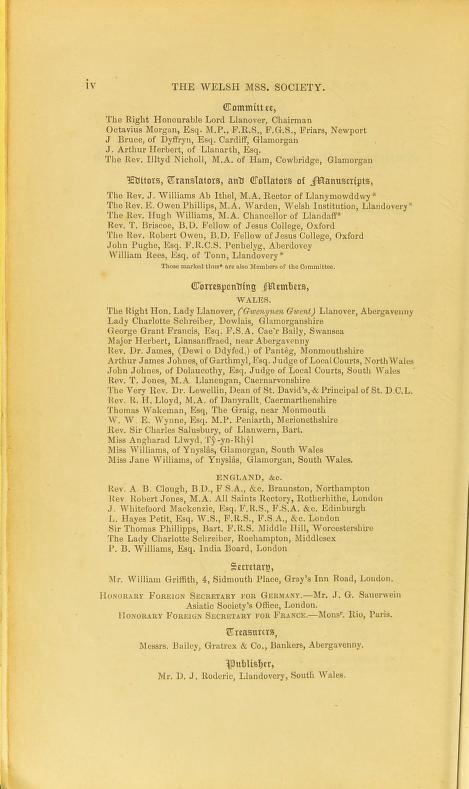
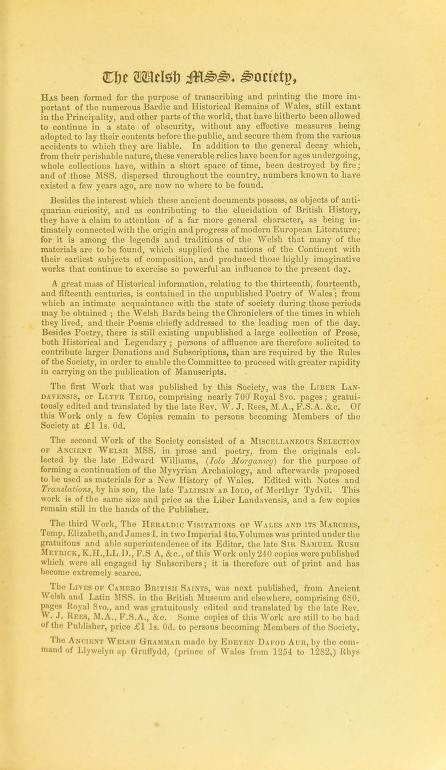
UK Pharmaceuticals especially drugs developed rapidly from this one small book! The building blocks of pharmaceuticals in the UK!
(P.S. There’s gonna be few errors in this one because it’s directly a translated in Medieval English! So just bear with me!🙃)
Additional links:
https://www.visitwales.com/attraction/visitor-centre/myddfai-community-hall-1526425
https://museum.wales/articles/1119/Old-cures-Amgueddfa-Cymrus-Historic-Medicine-Collection-/
https://museum.wales/articles/2160/Traditional-Medicines-/
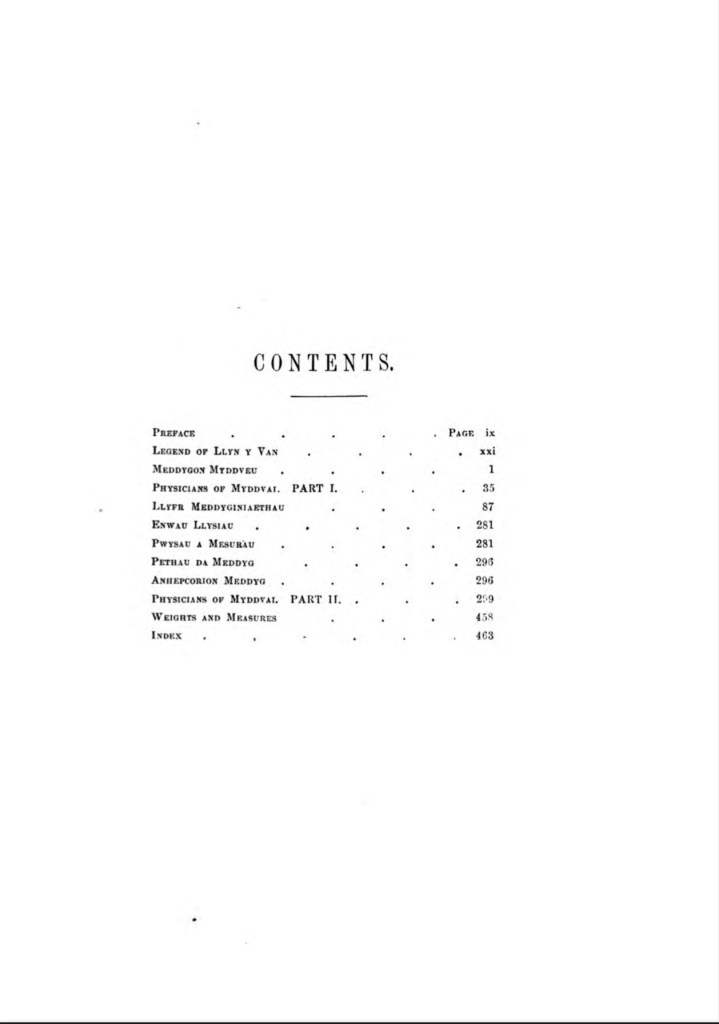
Source: The Physicians of Myddvai; Meddygon Myddfai (Welsh + Welsh translated to English)
https://archive.org/details/b2475769x
https://archive.org/details/physiciansmyddv00willgoog/page/n13/mode/1up
 Scriveners Online©
Leave a comment