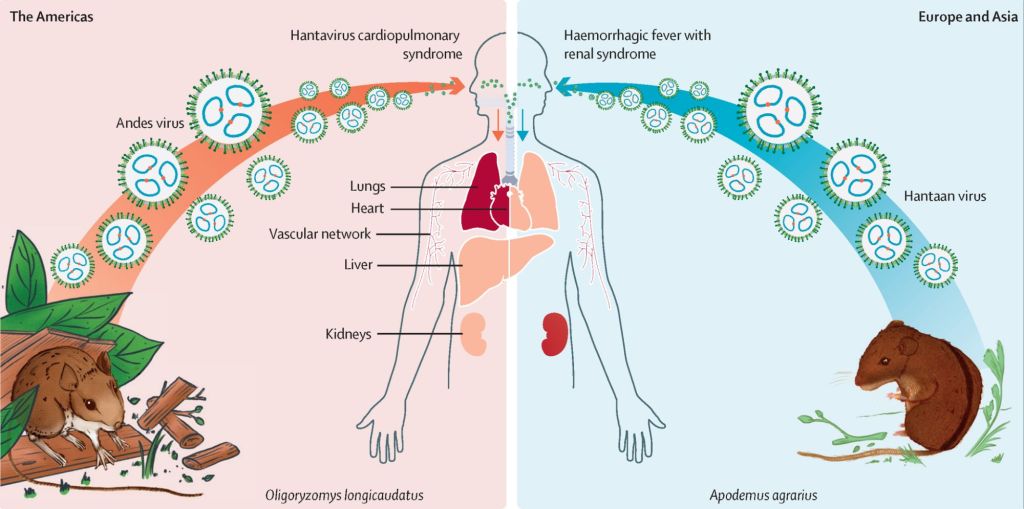
Hantaviridae are a family of enveloped single-stranded RNA viruses. There are over 50 hantavirus species, causing 2 major, sometimes overlapping, clinical syndromes:
Hemorrhagic fever with renal syndrome (HFRS), which is endemic to Europe and Asia
Hantavirus pulmonary syndrome (HPS), which is endemic to the Americas
Viruses causing HFRS are Hantaan, Seoul, Dobrava (Belgrade), Saaremaa, Amur, and Puumala.
Viruses causing HPS vary by region (1):
Argentina: Andes, Araraquara, Bermejo, Juquitiba, Lechiguanas, Leguna Negra, Maciel, and Oran virus
Brazil: Araraquara and Juquitiba virus
Chile and eastern Bolivia: Andes virus
North America: Sin Nombre, Black Creek Canal, Bayou, and Monongahela virus
Panama: Choclo virus
Paraguay and Bolivia: Leguna Negra virus
Hantaviruses occur throughout the world in wild rodents, which shed the virus throughout life in saliva, urine, and feces (2). Bats, moles, shrews, reptiles, and fish have also been shown to carry hantaviruses. Transmission to humans has only been documented from rodents through inhalation of aerosols of rodent excreta or, rarely through rodent bites. Human-to-human transmission can occur with Andes virus. In addition to naturally acquired infections, laboratory-acquired infections and those occurring without clear exposure to excreta of infected animals are becoming more common.
Laboratory diagnosis of hantavirus infection is established by serologic tests and reverse transcriptase–polymerase chain reaction (RT-PCR). Serologic tests include enzyme-linked immunosorbent assay (ELISA) and Western and strip immunoblot assays. Serologic diagnosis in North America must be able to differentiate between Seoul and Sin Nombre virus infections due to potential cross-reactivity. Growth of the virus is technically difficult and requires a biosafety level 3 laboratory.
Hemorrhagic Fever With Renal Syndrome
Hemorrhagic fever with renal syndrome (HFRS) is a group of similar illnesses caused by hantaviruses, which includes epidemic hemorrhagic fever, Korean hemorrhagic fever, and nephropathia epidemica; these begin as a flu-like illness and may progress to shock, bleeding, and renal failure. Diagnosis is with serologic tests and polymerase chain reaction (PCR). Mortality is 6 to 15%. Treatment includes IV ribavirin.
• Some forms of hemorrhagic fever with renal syndrome are mild (eg, nephropathia epidemica, caused by Puumala virus, as occurs in Scandinavia, the western part of Russia , and Europe). Some are usually mild but occasionally may be severe (eg, Seoul virus that has world-wide distribution in wild brown and domesticated rats). Others are severe (eg, that caused by Hantaan virus, as occurs in Korea, China, and Russia, or by Dobrava [Belgrade] virus, as occurs in the Balkans).
• Infection is transmitted to humans via inhalation of rodent excreta.
Symptoms and Signs of HFRS
• Incubation is about 2 weeks but can be a long as 6 weeks (1).
• In mild forms, infection is often asymptomatic.
• Symptomatic HFRS progresses through 5 phases: febrile, hypotensive, oliguric, polyuric, and convalescent (2).
• The febrile phase has a sudden onset, with high fever, headache, backache, nausea, vomiting, and abdominal pain.
• Relative bradycardia is present, and hypotension occurs in about 11 to 40% of febrile patients, with shock in about one-third. Seizures or severe focal neurologic symptoms occur in 1% (3). Hemorrhagic complications due to thrombocytopenia may develop (eg, epistaxis, petechiae, gastrointestinal bleeding, hematuria).
• Thrombocytopenia may occur early, even before cardiac symptoms, and the degree of thrombocytopenia is associated with risk of systemic inflammation and development of severe acute kidney injury (1). The oliguric phase is associated with the highest risk of mortality; oliguria is followed by polyuria and improvement in renal function.
More information…
https://youtube.com/shorts/yu6PAD-QYHQ?si=98EP93HhPGlA8vHC
What the…
https://youtu.be/9f0rn9zo5Mw?si=jvDvOVTxdhypGrTw
For comedic purposes only,
https://youtube.com/shorts/wPTdGDLRLmI?si=2tl0djnYMpnNOIs-
The current scenario so far,
https://youtube.com/shorts/ohG8YPIvTko?si=cgCTJQsQzRQSVcrN
https://youtu.be/lYt3S43c2-o?si=brcaJ-oi6nqug230
Most recent case of the Hantavirus, (not cruise related!)
https://youtu.be/YI2f1DTYqPY?si=ftKBOZ1cbpvJZ4aY
https://youtu.be/J30J4GVvmR4?si=ZpA0BeuvGStl69Pm
Hantavirus History in a Nutshell
Watch “What a case of Hantavirus looks like” on YouTube
https://youtu.be/R5PqcngCWp4?si=h2rmnbuBF7wwE3Mb
Hantavirus
Watch “How Hantavirus Kills” on YouTube
https://youtu.be/aX2uZGOaZJg?si=mH7c4ce0qSrZWbR5
Extracted from;
Merrick Manual Professional Version
Hantavirus Infection
Lancet Infectious Diseases Vol 23, Issue 9
 Scriveners Online©