Elaborating on the Ethical Challenges of Equal Representation in Biobank Research
This is a very important topic as we’re talking on the profound transformation of medicine. This is about AI, precision medicine and cross-border research. Age, sexual differences, ethinc origin, socio-economic condition and health literacy.
Health disparities – these are preventable differences in health outcomes and healthcare access that adversely affect specific populations. These disparities manifest in disease prevalence, mortality rates, and the quality of clinical care received. One of the most common one is socio-environmental barriers like low socio-economic status.
Under-reserved rural populations have healthcare disparities.
Clinical trials around 50% of them are less accurate because of under-representation.
The problem with biobanks
The participation rate for UK Biobanks is around 5%. There is a demographic skew, the older individuals are mostly likely female, from less deprived areas with white ethnicity. The volunter gap has a 50% less mortality than the general population.
The biobanks are also of healthy individuals, who have healthier lifestyles; smoke less, less obese, and drink less alcohol.
There is a dire need to prevent a relapse of the representation gap.
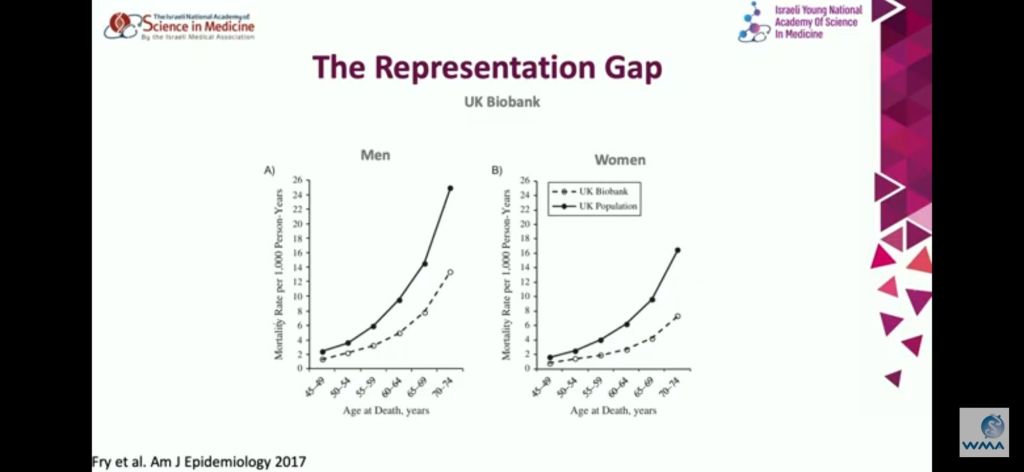
Healthy Volunteer Paradox
When participation is voluntary, the research has limitations due to unbalanced data.
Revision Suggestion 1
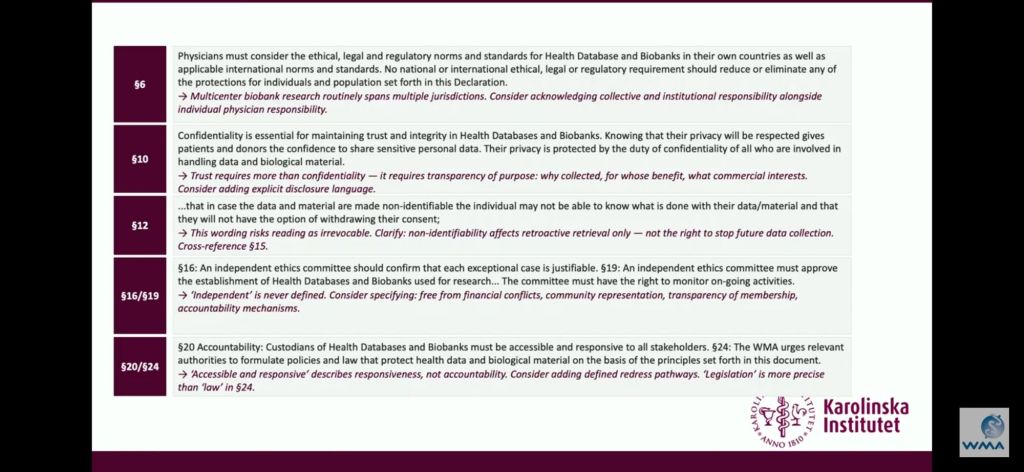
To ensure that health databases and biobanks equitably benefit society and do not exacerbate existing health disparities, custodians must actively implement recruitment strategies that prevent systematic selection biases, such as the healthy volunteer paradox, and promote comprehensive demographic representativeness.
Revision Suggestion 2
Governance arrangements shall mandate the continuous, longitudinal assessment of participant demographics to identify and address representation gaps over time, ensuring that historically underrepresented populations are meaningfully included and share equally in the benefits of scientific advancement.
Revision Suggestion 3
AI systems are integrated into biobanks, clinical registries and clinical trials should adopt equity-aware data governance and function as active ethical tools that systematically detect underrepresentation, ease access for low SES population, assess unmet clinical needs, and initiate targeted corrective actions.
Revision Suggestion 4
Data science and algorithms should be purposefully designed as an ‘equity compass’ that translates the ethical principles of inclusion and public benefit into operational public-health tools, ensuring that resources are redirected to populations experiencing the greatest risk and the lowest protection.
Revision Suggestion 5
Biobanks are evolving into functional human platforms, including iPSC banks, organoid bio-twins, “village in a dish,” and “clinical trials in a dish”. As these symptoms may guide drug discovery, toxicity testing, AI development, and regulation, they must mandate equitable representation across gender, ancestry, race, ethnicity and disease subtype, and relevant determinants of health. Without such governance, next-generation biobanks may reproduce existing inequities rather than correct them.
How can data science and artificial intelligence improve inclusion and representation?
Can AI aggravate the situation?
PROMs – (patient reported outcomes)
are evaluations made directly by patients concerning their health, symptoms, level of functioning, satisfaction with treatment and so on, without any input from their family, carers or healthcare professionals. Its a tool to capture PRO imformation, usually in the form of questionnaries. PROMs are commonly used in clinical trials and are increasingly being used in clinical research and practice; for instance, to evaluate the impact and effect of novel drug treatments, monitor symptoms, and facilitate communication between patients and their healthcare professionals. Reimbursement agencies such as the UK’s National Institute for Health and Care Excellence utilise PROMs for the cost effectiveness analysis of new drugs and medical interventions. Bodies such as the US Food and Drug Administration and the European Medicines Agency have set new benchmarks for the properties required for PROMs when used to demonstrate patient benefit in clinical trials.
PROMs could take on many forms; some measures are generic, and others are diseasee or condition specific.
Generic PROMs are designed to assess the general aspects of health that are not specific to any disease. Disease-specific PROMs assess aspects of health that are specific to a goven disease.
*****
94.6% of UK Biobank participants are White.
<10% of cancer trial participants are minorities
The US All of US programme reached 46% minority participation demonstrating that diversity is achievable.
Assumptions regarding PWIDD to avoid in biobank research
• ableist bias
• reductionist bias
• eugenic bias
Experiental
Reflections on experiences of a health condition, care approach, intervention, or health care system derived from the following:
• patients with IDD or caregivers
• other informants
Ramifications
• Include relational agency and inter-dependent deciding as a basis for ‘consent’
• Specify research ‘benefit’ as preserving and promoting integral flourishing of ALL
• Purge based assumptions in biobank research
• Address the issue of equity for under-represented groups
The Refounding of Autonomy and Governance: consent in relation to databases
The Declaration of Taipei revoluntionised the use of broad consent in biological databases by conditioning it on strict governance. Frameworks like the US Common Rule are deeply rooted in western individualism. To balance this, H3Africa Initiative and WHO (2021) reintroduce a collective dimension to accomodate non-Western contexts.
Global bioethics imperatively requires that it concludes in individual free and informed consent, ensuring every participant retains personal autonomy and a full understanding of the research implications.
The architecture of combining hard law and private law, safeguards the sovereignity of population origin against the unilateral exploitation of global genomic resources.
Conclusion
To meet the challenges posed by disruptive biotechnologies, the Taipei Declaration must be updated with four key ethical amendments:
1. Distributive Justice and Reciprocity; drawing inspiration from the Nagoya Protocol, this amendment would require equitable sharing of clinical and scientific benefits. It aims to eliminate North-South extra-activism by mandating co-authorship and the contractual sharing of intellectual property.
2. Dynamic consent; Integrating a digital, evolving, and layered consent model (WHO 2021) that ensures continuous transparency (Council of Europe 2016) and is inextricably linked to systematic community engagement (H3Africa 2018).
3. Biological sovereignity: Elevating omics data and biological samples to the status of a sovereign and inalienable heritage of source populations (RMHGR 2019).
4. Binding Governance: Systematically legally enforceable MTAs/DTAs under strict IRB and ethics committee oversight guarantees absolute resource traceability (Council of Europe 2016; H3Africa 2018).
All Keynote Speakers;
Laura Palazzani
Christofer Lindholm
Oren Caspi
Heidi Stensmyren
William Sullivan
Jacques Simpore
Part 2 Declaration of Taipei
https://youtu.be/b9wEquVaGN4?si=nzk0PXOQS11R7sNu
Sources;
https://whatisseries.co.uk/what-are-proms/
https://sites.google.com/ualberta.ca/apersu/about-proms/what-are-proms
https://www.sciencedirect.com/science/article/pii/S2772766125000278
 Scriveners Online©