





“Oh, give me a home where the buffalo roam,
Where the deer and the antelope play,
Where seldom is heard a discouraging word,
And the skies are not cloudy all day.”
A film crew gets access to record a documentary in the premises of the Brockville Mental Health Centre, in the course of 18 months, revelations of the patient’s realities and the staffs responsibilities makes us ponder over the question asked for all patients; ‘Will mentally ill patients who have committed violent acts and have violent-like tendencies ever truly be accepted by the community and does that lead to complete rehabilitation?’
We’ve covered Psychotic Disorders in this series, if you’re new to the blog or you’re looking for a little food for your intellectual mind, you’re at the right place! 😉
https://scrionl.blog/2025/09/17/transforming-under-the-full-moon-a-tale-of-many-werewolves/
We’ve also covered prison life for England’s immigrant communities, if you’d like to check it out, its right here;
https://scrionl.blog/2026/03/01/the-experiences-of-being-a-doctor-in-prison-hmp-huntercombe/
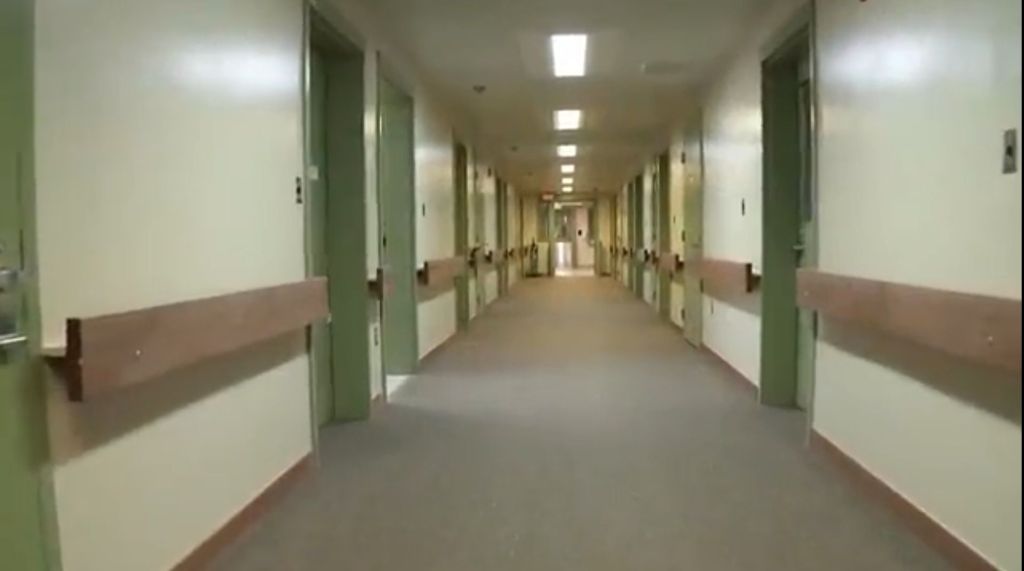
Alright now let’s take a visit to the long narrow corridors where the filming crew shows us…
There are five individuals, who for not just the sake of rehabilitation and the fact that they’re humans and humans do mistakes, but for the small part of humanity in them, we will or should I say, I, will refer to them as sick at the time of these acts and the aftermath that followed.
Our first friend; Michael Stewart
His offences were second degree murder, his record says that he’s not criminally responsible in his legal status. At one point, he was part of the popular crowd in his much younger years and was at the top of his class, he was sharp, confident and funny as described by his brothers. It was in the spring of 1997, when he started to get sick and became recluse, recalled one of his brothers.
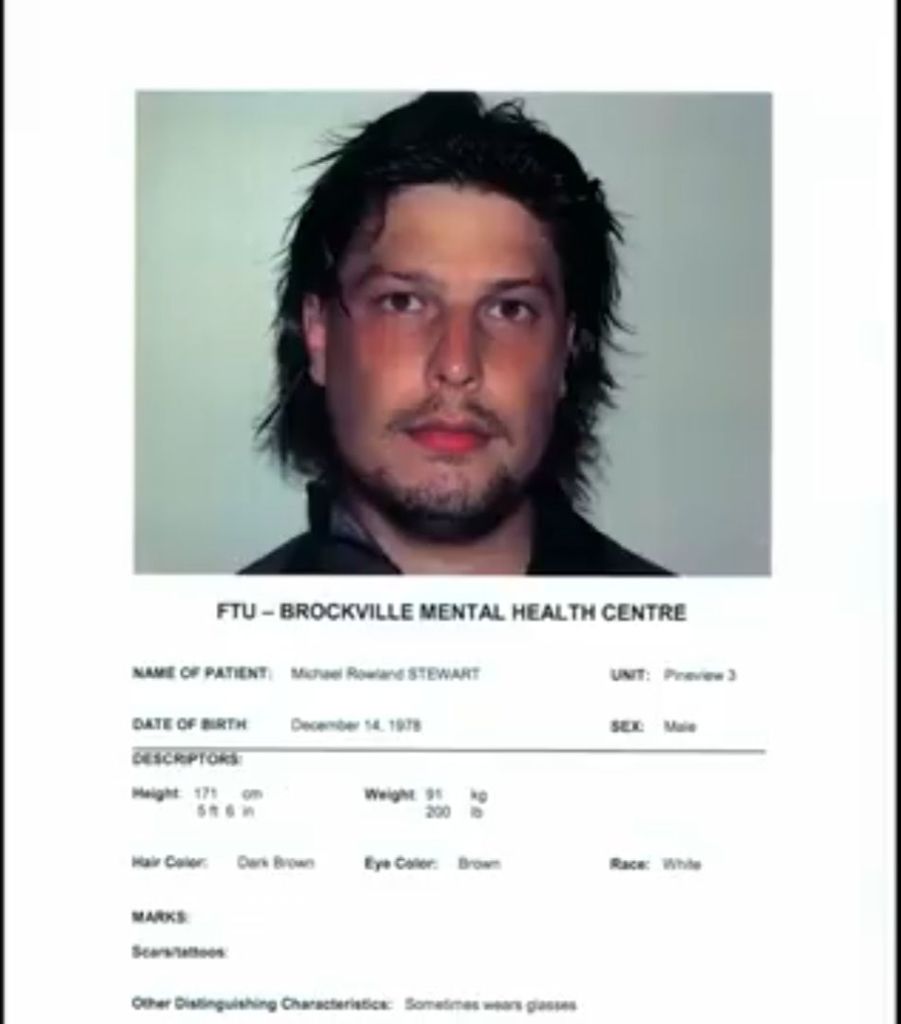
Rebecca Stewart mentions that he felt as if his mom could read his mind. Nancy Wooding, reads out, “Mike is making slow, steady improvements, but some negative symptoms remain. His overall mood is good, but quiet… he usually maintains a quiet demeanor about the ward.”
He’s become sensitive to social situations. even so, that he’s turned down the opportunity to go into the community on his own… sensitive that people might find out what he did 10 years ago.”
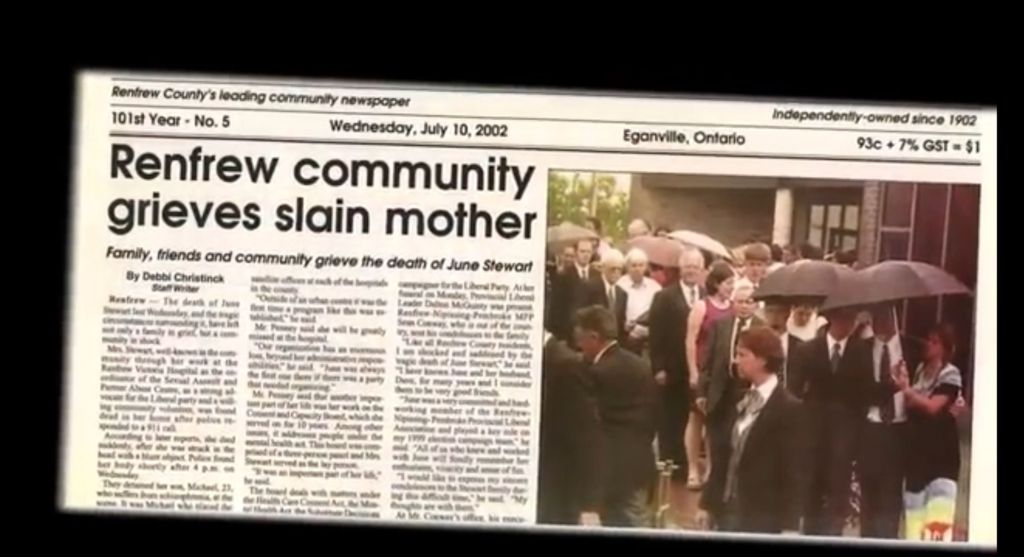
His sister smashed the receiver end of the phone after hearing the news that he’d killed their mom, she found it hard to believe, he confronted his mother and the altercation resulted in severe blunt trauma to the head killing her on the spot.
His mother was a nurse by profession who loved serving the community and her family. She would cry herself to sleep, knowing that her son is suffering from this illness. When he was well enough, he was emotionally aware of that his mother was crying deep down.
He takes clozapine that’s an anti-psychotic. If he stops taking the medicine, some of his big problems could return. Each relapse he gets, does additional damage to his brain. He finds the whole incident difficult to discuss.
Dr John Bradford examines him and is his psychiatrist.
When one’s is freshly admitted to the Brockville Mental Health Centre, the room is up on the fourth floor, its B1, B2, B3, B4 as Micheal explains, it’s something heavy weighing on the back of his mind, he’s killed his own mother. B4 is a unit, a corridor that’s got rows of doors on your left and right, the most serious of patients are put in this unit, everyone’s a patient. It’s a hazardous environment, for not just a healthcare worker and patient but it could also potentially risk the quality of care, turn it to a vulnerability if you will.
The unpredictability is what makes it perilous for the psychiatrists and the nurses for the most part. I find the relationship dynamics in these type of settings particularly interesting.
“Most of them are new people that we don’t know that well, and they haven’t been stabilised on meds.” explains Charles Decou who’s one of the nurses working there.
“Could be very frightening if you weren’t psychotic, and of you happen to come in and you’re in for an assessment, and you aren’t florid psychotic, then I imagine it would be a very frightening visit to the circus,” he continues.
There is a nursing station, to treat or provide care, there’s also a board that can be locked to close the entry if things get to a worst. There’s a program called ‘Symptom Management,’ they ask him questions such as ‘Does it sound like a person talking to you or does it sound like someone is in your head?’ ‘What do the voices say?’
Carole Seguin
“Can you tell the difference, when the voices are real or not real?”
“Any voices you hear… are the voices in your head.”
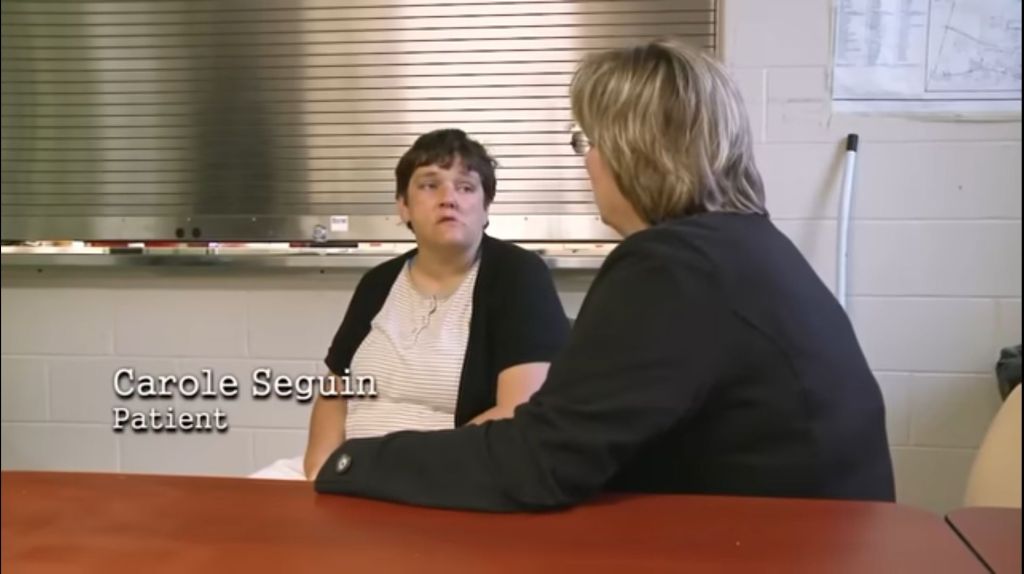
She’s a 39 year old female, she was found NCR, on account of mental disorder, on two charges of assault on a police officer and four charges of assault on September 20th, 2010. She’s estranged from her family, she was a ward of the Children’s Aid Society at the age of 11 years. When she’d get upset she’d run into traffic, She’d treathen to suicide if the ACT team worker left and this also explains why she has countless orthopaedic injuries all over her entire body. Women’s health as medical school fails to teach you is extremely volatile in a women’s world when it comes to psychotic disorders. She has a gait difficulty. She has a chart where she gets stickers for good behaviour, and if she gets all 14 without missing a box or a row, they could order food or save that money for whatever you wish to buy.
Its hard for her to get a whole month of stickers. Dr Elizabeth James is her psychiatrist. At one point, she banged her head repeatedly on the cement walls.
She has delusions that people are talking very badly of her on the TV, hateful comments and that makes her cry, she gets bad sleep and its been for almost a month!
In 2005, when she came she was so wild and out of control. And in two years her risk was low says nurse Mark Earle. Ten minutes later she can be very different telling things like you raped me to him, later on, she’d open up to Dr Elizabeth saying that she doesn’t remember saying it. Mr Mark had reported it and it was looked into.
She admits to her doctor that nothing as such had happened and that it was all in her head. She never had such an incident with him. She punched 4 holes into the walls and given black eye to someone.
Sal Beninato
He was diagnosed with schizophrenia in 1996, there were a series of violent outbursts against his family, he reported hearing voices.
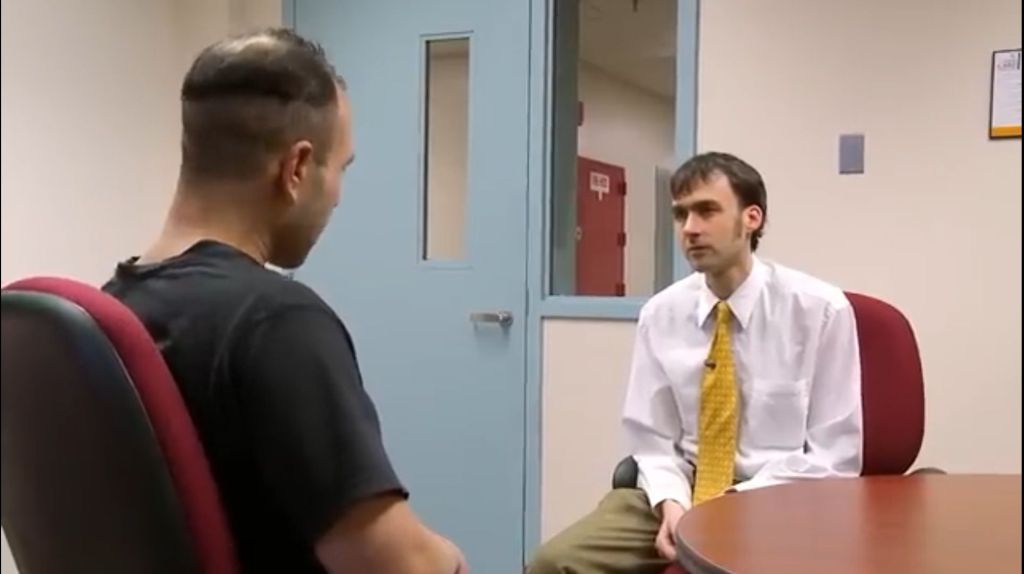
Dr Jonathan Gray is his Psychiatrist.
In 2003, he came home and while dad was watching television, he asked his mom for a cigarette, when she replied saying that she didn’t have one, he was agitated amd grabbed her by the hair and shook her around, she was unconscious. He called for an ambulance saying that it was a temper tantrum, obviously that wasn’t the case here, his mother was placed in intensive care and was comatose for weeks. His mother suffers with irreversible neurological damage and she now walks with a cane.
Dr Gray adds, “He downplays what he has… to get out of the hospital quicker.”
“Nah, no I really don’t hear voices, sometimes I think they’re my thoughts and stuff…” responds Mr Beninato.
His family don’t want him back and are living in ‘thoughtful fear’ at the sight of him coming back. He misses not having friends, staff and patients not communicating with each other outside professional boundaries. He hangs out with Greg for smoke. By the way, almost all the patients smoke.
Lunch is delivered on a scheduled basis, regularly from ward to ward, B4-B1.
All patients here are absolutely capable of inflicting harm on themselves or others for no reason. Women make the worst patient according to nurse, Charles.
There are 59 patients in the Forensic Treatment unit out of which about 5 are women. The men have an extrinsic violence while the women express it inwards. The women who come in are either bipolar or schizo-affective (mood).
Al
He complains about constantly being present around females, one of the nurses makes him promise that he hasn’t hit either of them.
Justine
She’s an attention seeker in the sense she will go by all means to be self-abusive and self-inflict wounds and cite reasons like craving an addiction of adrenaline rush. She’s diagnosed with bipolar disorder and hypochondriac. Individuals are known to take risks injurious to health.
She lit fire downstairs when she angry at a staff member, she lit her pillow on fire. An announcement on the microphone that medicines are being handed out and this happens four times a day. The patient has a legal right to refuse the medication, if the patient feels that it is not working for them or harming them. It’s legal in Canada.
Some patients hold the medication with the help of their tongue, swallow plain water and spit out the medicines later. If any patient refuses medication, then some of the older methods of coping will come into play.
She and Aisha Smith also tied strings around their necks. She used a face cloth as a ligiture, tightly around her neck, had herself strangled and she was found on the floor of the showers all blue-faced, and unresponsive. A code blue was initiated and noose knife was used to cut the ligiture around her neck. The colour started to return to her face and she responsive.
“Sometimes its just a matter of time if we save them or not.” Nurse Wooding.
Further reads…
Source: National Post https://share.google/u8kzZaDU1yIyxjF1S
What Do You Do When Your Star Quits Your Film? | HuffPost https://share.google/ZDKSOv7WMSFeHnAAk
Source;
OUT OF MIND OUT OF SIGHT : Inside the Brockville Psych
 Scriveners Online©
Leave a comment