❝Never do anything by halves if you want to get away with it. Be outrageous. Go the whole hog. Make sure everything you do is so completely crazy it’s unbelievable.❞
-Roald Dahl, Matilda (1988)
A ‘med comms’ site for everyone!
✒︎ Informative
Presenting the latest news, discoveries and innovations in medicine in a blog-style format!
⚕ Global
Reaches the national and the international readers!
♛ Unique & Dynamic
There’s an article for everyone in all areas of medicine!
#scriveners
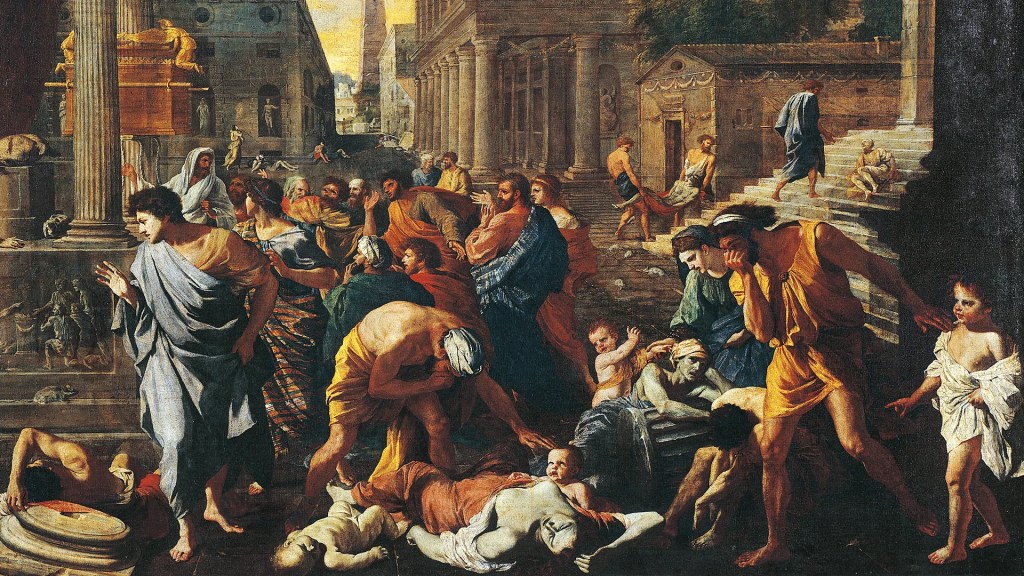
The Plague of Ashdod (1630) Nicholas Poussin
The artwork “The Plague of Ashdod” was created by the French painter Nicolas Poussin in 1630. It portrays the biblical narrative of a divine plague inflicted upon the people of Ashdod.
This dramatic scene of divine punishment is described in the Old Testament. The Philistines are stricken with plague in their city of Ashdod because they have stolen the Ark of the Covenant from the Israelites and placed it in their pagan temple. You can see the decorated golden casket of the Ark between the pillars of the temple. People look around in horror at their dead and dying companions. One man leans over the corpses of his wife and child and covers his nose to avoid the stench. Rats scurry towards the bodies. The broken statue of their deity, Dagon, and the tumbled down stone column further convey the Philistines’ downfall.
In the artwork, Poussin vividly depicts the turmoil and suffering caused by the plague. The foreground is filled with the stricken inhabitants of Ashdod; their bodies are contorted in agony or limp in the stillness of death, illustrating the mercilessness of the affliction. The variety of postures and expressions captures the range of human suffering and chaos that accompanies such disaster.
Amongst the afflicted, several figures stand out due to their dynamic gestures or central placement within the composition, drawing the viewer’s eye and emphasizing the emotional impact of the scene. In the background, classical architecture gives a sense of order and permanence that starkly contrasts with the disarray and despair of the figures. Poussin’s use of colour and light skilfully highlights the drama, with the dark and earthy tones of the suffering masses set against the lighter, more serene sky, which suggests divine presence or intervention.
Poussin’s use of color and light skillfully highlights the drama, with the dark and earthy tones of the suffering masses set against the lighter, more serene sky, which suggests divine presence or intervention. The overall effect is one of a carefully structured scene that conveys a narrative full of intensity and profound human drama, characteristic of the religious paintings of the period and the classical style Poussin is renowned for. Poussin began to paint The Plague of Ashdod while the bubonic plague was still raging throughout Italy though sparing Rome. He first called the painting The Miracle in the Temple of Dagon, but later it became known as The Plague of Ashdod.
The painting most importantly provides a view into how illness and diseases were feared at that time in the past and the fact that people had the knowledge that it was transmissible during that time period which was the 16th century.
This piece is dedicated to the real doctors through and through… A hospital-issued photo ID attached to his quarter-zip top with a retractable clip, granting access to countless doors, closets, wards that otherwise would be inaccessible. A silver Zebra F-701 retractable ballpoint pen purchased for $4.99, selected for the particular click it makes when protracting…
There were more questions because it makes things more complicated. The eligibility for the participation of the reimbursement for GPs; locums are to be converted into salaried GPs! Yep! You heard that right! There are so many questions that need to be answered! When politics get involved, answers to certain questions aren’t there! What do…
Edwards Lifesciences has received FDA approval for their invention TRIFORMIS RESILIA this week, it is the first surgical valve that is designed to specifically replace a diseased tricuspid valve of the human heart. Only 2.5% of patients out of 1.6 million ever receive a tricuspid valve replacement in their lifetime. Historically, innovative efforts to intervene…
Introduction: Good Sh*t Dr Ben Mullish, a clinical scientist at Imperial College London, was running a trial of FMT in patients with C. diff infections. Ray was so unwell that Dr Mullish offered him the treatment. Heather understood that there are good and bad bugs and advised her husband to go ahead with it, but…
Scrapping the legal guarantee that a nurse sits on every foundation trust board is a “brazen attack on patient safety”, the Royal College of Nursing has warned. The Health Bill, published this month, would remove the requirement in primary legislation for foundation trust boards to include a registered nurse or midwife and a registered medical…
Is there a way to reverse the declining axon elongation? Scientists at Cambridge have proved otherwise. The three-dimensional patient-specific induced pluripotent stem cell (iPSC)-derived organoids emerge as vital discovery models shedding light on human aspects of neural physiology and disease. They generated and validated a human corticospinal connectoid system, comprising regionally segregated air-liquid interface cortical…
Researchers from the Department of Clinical Medicine at Aarhus University have been able to demonstrate for the first time that the memstrual cycle affects a plethora of proteins in the female body. This is explored by one of the leading researchers who is behind the study – Jonas Ghouse. This study is published in the journal Nature Medicine.
“The study shows that the body’s building blocks—proteins, change to a far greater extent during the menstrual cycle than previously recognized,” he says. Researchers have identified close to 200 proteins that change in its entirety throughout the menstrual cycle.
Several of these proteins are found to have been linked to conditions such as ednometriosis, uterine fibroids, and bleeding disorders. Nearly 3,000 plasma proteins from 2,760 women’s health data from the UK Biobank were profiled on and 198 varying proteins across the menstrual cycle were identified. This study was carried out in younger and older women. These formed distinct temporal patterns that aligned with their corresponding menstrual phases. These proteins include reproductive hormones, cytokines and growth factors, many of which are enriched in endometrial tissue and expressed in epithelial and stromal cell types, highlighting their biological specificity. Several proteins were linked to common reproductive disorders, including endometriosis, leiomyoma and abnormal bleeding. Finally, we developed a proteomic score on the basis of 75 proteins that accurately predicts menstrual cycle phase.
These findings can help provide a menstrual cycle atlas on a systematic level and keep informed of biomarkers essential to a women’s health.
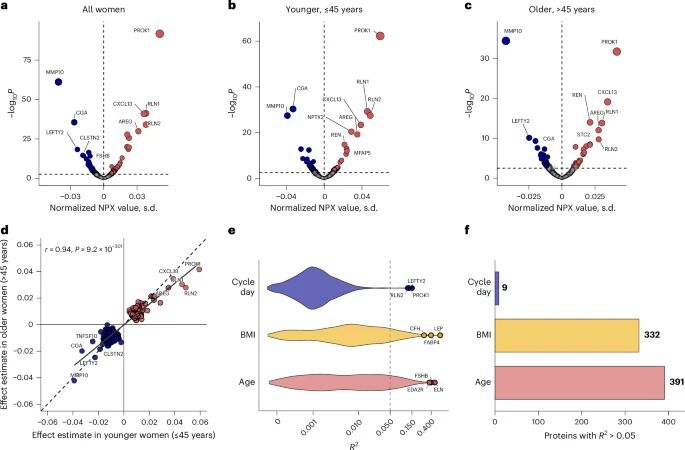
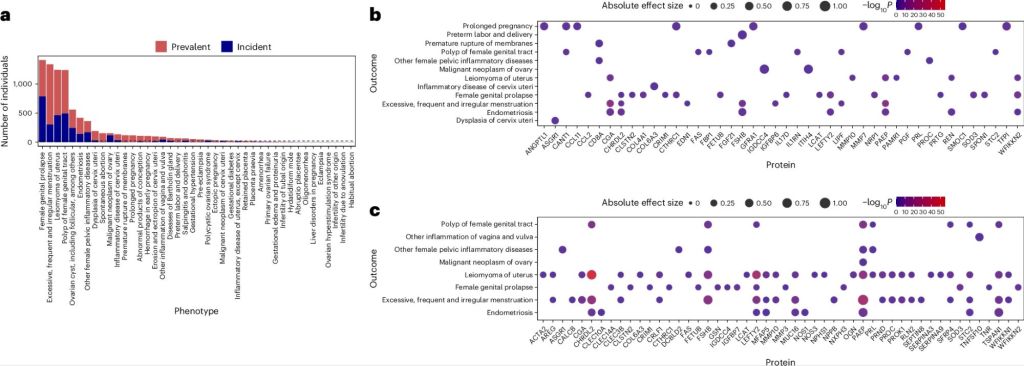
a, A volcano plot of associations between circulating protein levels and menstrual cycle day in all women (N = 2,760). b, A volcano plot in women ≤45 years (N = 1,421). c, A volcano plot in women >45 years (N = 1,339). In a–c, each point represents one protein, with the x axis showing the normalized protein expression (NPX) value (s.d. units) from the linear regression model and the y axis showing the −log10 P value (two-sided). The red points indicate proteins positively associated with cycle day, and the blue points indicate proteins negatively associated with cycle day, at an FDR < 0.05. P values were corrected for multiplicity using Benjamini–Hochberg correction. Analyses were adjusted for age, BMI, smoking status, self-reported ancestry, time between blood draw and proteomic measurement, and batch. Top associations are annotated on the plot. d, A comparison of effect estimates for protein–cycle day associations between younger and older women. Each point represents a protein, with x- and y axes showing the estimated regression coefficients in younger and older women, respectively. The dashed line indicates the reference line, and the solid line represents the fit linear regression. e, The distribution of variance explained (R2) by cycle day, BMI and age from separate natural cubic spline models. The dashed line marks R2 of 0.05. The points and labels denote the top five proteins per predictor. f, The number of proteins with R2 > 0.05 from the same spline models.a, The distribution of prevalent (red) and incident (blue) diagnoses among women in the UKB cohort with available proteomics data (N = 23,674). b, Protein-prevalent disease associations (FDR < 0.05) across 12 reproductive health conditions. The dot size indicates absolute effect size (logOR per s.d. increase in protein level), and the colors represent −log10P (two-sided). c, The protein–incident disease associations (FDR < 0.05) across eight conditions, with dot size and color as in b. In b and c, protein–disease associations were estimated using logistic regression models adjusted for age, BMI, smoking status, self-reported ancestry, time between blood draw and proteomic measurement, and batch. P values were corrected for multiplicity using Benjamini–Hochberg correction.
“Copyright [2024], [2025], [2026], [Scriveners], [Scriveners Online], All Rights Reserved. Any unauthorised duplication or use of this material is strictly prohibited.”





 Scriveners Online©
Leave a comment